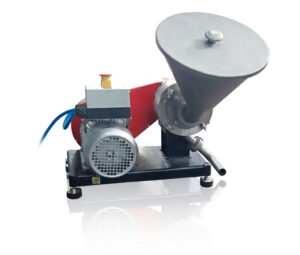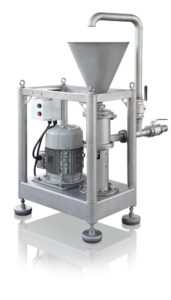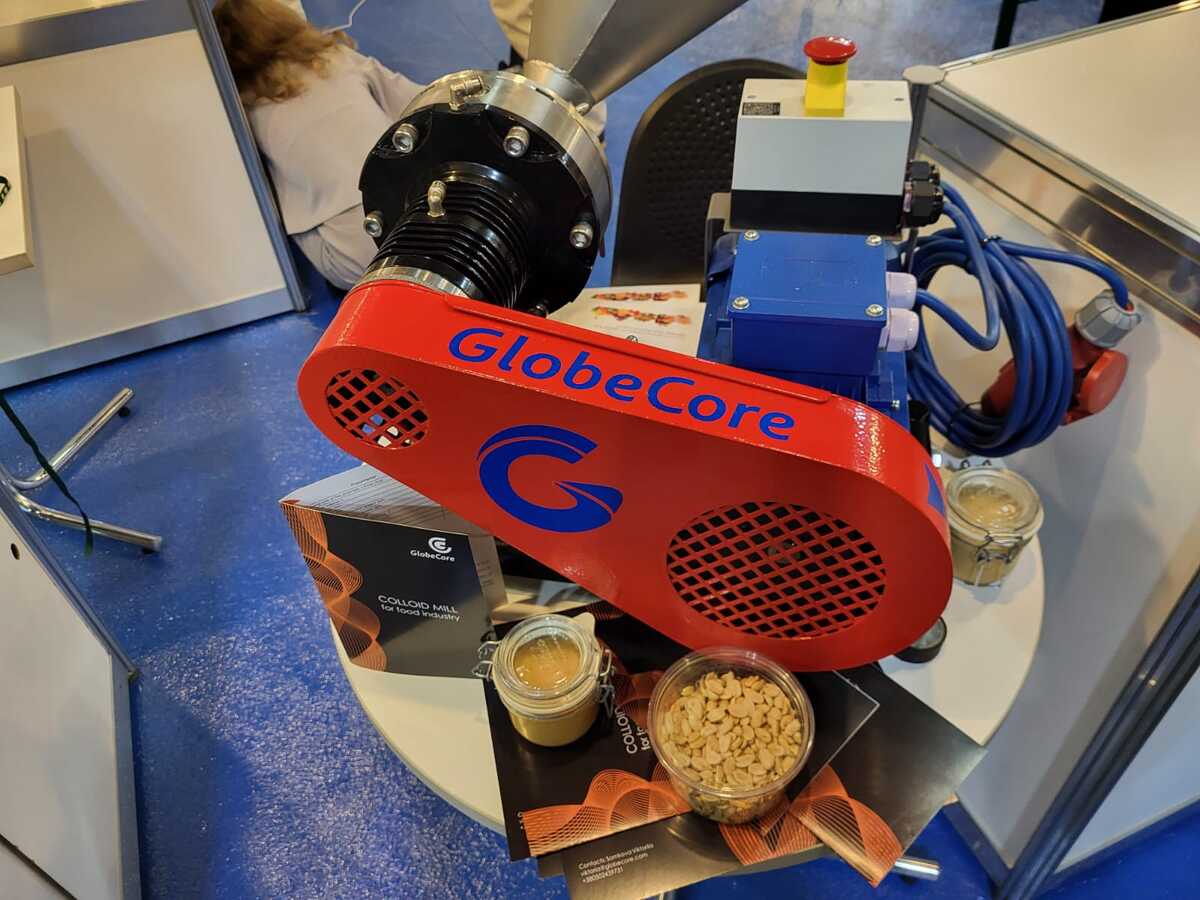
A nuts grinder must be selected according to the product you need, not the machine name. If the target is a dry, free-flowing nut meal or powder, the process requires dedicated dry-grinding equipment. If prepared nuts release oil and become a flowable paste, the operation changes to wet particle-size reduction, dispersion, and homogenization. A colloid mill such as the GlobeCore CLM-100.3 can be evaluated for that wet-processing stage, but it is not a general-purpose dry grinder or a complete nut-processing line.
The first engineering task is therefore to define the feed and target product. Whole nuts, dry granules, smooth nut paste, a formulated spread, and an emulsion-based filling require different process arrangements. The word “grinder” alone does not resolve those differences.
What process must the nuts grinder perform?
A nut-processing project may involve several distinct unit operations. Only some belong inside a colloid mill.
| Required result | Main operation | Appropriate equipment direction |
|---|---|---|
| Dry meal or powder | Dry particle-size reduction | Dedicated dry grinder; a colloid mill is not the default choice |
| Coarse nut pieces | Cutting or crushing | Crusher, cutter, or coarse grinder selected for the required piece size |
| Flowable nut paste | Wet particle-size reduction, dispersion, and homogenization | Colloid mill may be evaluated after suitable feed preparation |
| Formulated spread or filling | Dosing, bulk mixing, wet milling, and thermal management as required | Multiple machines integrated into a process line |
| Liquid emulsion containing nut ingredients | Mixing, dispersion, and emulsification | Equipment selection depends on formulation and required emulsion structure |
A mixer combines ingredients in bulk but may not deliver the required fine particle reduction. A disperser incorporates and distributes solids in a liquid. A high-shear mixer provides intensive mixing and may break agglomerates. A homogenizer is selected for a defined homogenization duty and its own operating principle. A ball mill uses grinding media and a different residence-time mechanism. These machines are not interchangeable merely because their application descriptions use words such as grinding, blending, or homogenizing.
When nut processing becomes wet milling
Prepared oil-bearing nuts can form a paste as their structure is reduced and oil is released. Once the material is a controllably flowing liquid or semi-liquid feed, the fine-processing stage is wet milling rather than dry grinding.
GlobeCore documentation identifies applications including macadamia-nut grinding and the production of peanut, hazelnut, pine-nut, cashew, and pistachio pastes. This confirms that CLM colloid mills are relevant to evaluation for nut-paste duties. It does not confirm that every nut variety, recipe, or feed condition can be processed under the same settings.
What a colloid mill does
In a rotor–stator colloid mill, prepared product passes through the working gap between a rotating rotor and a stationary stator. Relative movement in this zone generates intensive shear and turbulence. For a suitable flowable nut paste, the mill can provide fine wet particle-size reduction, break down soft agglomerates, disperse solids through the oil-bearing phase, and improve product uniformity.
The working gap is a process variable, not a universal recipe setting. Feed rate and the number of passes also influence the result. A more intensive setting or additional pass may alter mill load, flow behavior, and product temperature. These effects must be assessed with the real formulation.
What a colloid mill does not do
A food-industry colloid mill is one wet-processing stage. It does not replace equipment required for:
- washing, cleaning, sorting, and foreign-material removal;
- shelling, peeling, or skin removal;
- roasting, cooking, sterilization, cooling, or other thermal treatment;
- coarse crushing when the incoming feed is too large or irregular;
- dry grinding to make nut flour or powder;
- accurate ingredient weighing and dosing;
- bulk premixing when required by the recipe;
- storage, inspection, filling, and packaging.
Whole-nut processing capability should not be assumed. If the feed cannot enter the working zone uniformly, it needs upstream size reduction, conditioning, or a separately engineered feeding arrangement.
CLM-100.3 as a nuts grinder for paste production
The GlobeCore CLM-100.3 is a food-industry colloid mill designed for fine grinding of substances to a paste-like consistency and for producing thick slurry under high-shear conditions. Verified product information states that all wetted components are made from stainless, chemically resistant steel.
The documented unit capacity is 0.1 m³/h. That figure must not be treated as a guaranteed nut-paste throughput. Volumetric output can change with the nut type, formulation, initial particle size, solids content, viscosity, temperature, feed behavior, working-gap setting, and number of processing cycles. A nominal capacity stated for the unit—or a capacity measured with a different liquid—does not establish production performance for a specific recipe.
The CLM-100.3 is therefore relevant when the required operation is fine wet milling of a prepared, flowable paste. It should not be specified only because a purchasing list calls for a nuts grinder. Engineers comparing configurations can also review GlobeCore’s food-industry colloid mills and the practical guide to where a colloid mill fits in peanut butter production.
Feed preparation determines whether milling is stable
Initial size and contamination control
The feed must be free from foreign objects and prepared to enter the mill consistently. Large pieces and erratic feeding can cause uneven loading. Whether a separate crusher is necessary depends on the incoming material and cannot be decided from the nut variety alone.
Flowability and viscosity
A colloid mill requires material that can be delivered through its working zone under the planned conditions. Nut solids, naturally released oil, added oil, sugar, salt, stabilizers, and other recipe components can change viscosity and flowability. The ingredient-addition sequence also affects the material presented to the mill.
Provide measured viscosity at the relevant temperature whenever possible. Also report practical behavior such as bridging, settling, phase separation, or loss of flow. A formulation that is not reliably feedable may need different upstream preparation or transfer equipment.
Temperature management
Temperature can change viscosity, flow, texture, and the behavior of recipe components. It should be monitored during trials and production. The colloid mill must not be treated as a cooker, sterilizer, or final cooler. If the product has a narrow temperature window, separate heating or cooling equipment and suitable instrumentation should be integrated into the line.
Working gap, passes, and target texture
Target texture should be defined in measurable terms where possible. Particle-size requirements can be combined with practical criteria such as mouthfeel, spreadability, visual uniformity, and acceptable variation after storage.
Do not select the working gap and number of passes from a generic nut-paste recipe. Establish them by testing. Record at least:
- feed preparation and initial particle size;
- full formulation and solids content;
- inlet and discharge temperatures;
- viscosity at the stated temperature;
- feed rate and observed flow stability;
- working-gap setting;
- number of passes or recirculation cycles;
- resulting particle size, texture, and product temperature.
Actual results depend on the material, recipe, initial particle size, solids content, viscosity, temperature, feed rate, working gap, and number of processing cycles. Because these variables interact, a test using the customer’s actual formulation is the reliable way to confirm suitability when documented data do not cover the product.
How to integrate the mill into a nut-paste line
A practical line may include separate raw-material preparation, roasting or another specified heat treatment, cooling, skin removal, coarse size reduction, dosing, premixing, transfer, fine wet milling, holding, temperature control, inspection, filling, and packaging. The exact sequence depends on the food process and recipe.
Before selecting connections, define whether the mill will operate in one pass or with recirculation. Check how feed reaches the inlet, how discharge moves to the next stage, and whether the product remains flowable throughout the route. Piping, valves, transfer devices, vessel elevation, controls, sampling points, and access for inspection should be considered together rather than added after the mill is purchased.
Cleaning and utilities
Cleaning requirements belong in the equipment specification. State the cleaning method, chemicals, temperatures, sequence, frequency, and whether dismantling or an automated cleaning procedure is expected. Confirm that the selected arrangement provides access for cleaning and inspection and is compatible with the plant’s food-safety plan.
Utility data should cover the available electrical supply and any separately required water, compressed air, heating, or cooling services. Requirements must be confirmed for the selected configuration and complete line rather than inferred from the model name.
Practical nuts grinder selection checklist
- Define the product: dry powder, coarse pieces, paste, spread, filling, or emulsion.
- Define the operation: mixing, dry grinding, wet particle reduction, dispersion, emulsification, or homogenization.
- Describe the feed: nut type, preparation, initial size, temperature, and flowability.
- Provide the formulation: all ingredients, proportions, solids content, and order of addition.
- Set the production duty: required throughput, batch size, operating schedule, and acceptable recirculation.
- Specify the target: particle size, texture, mouthfeel, appearance, and acceptable variability.
- Set process limits: viscosity range, permissible temperature, and any sensitive ingredients.
- Plan sanitation: cleaning method, frequency, chemicals, temperatures, and access requirements.
- Check integration: utilities, inlet and outlet connections, transfer equipment, controls, and available space.
- Run a representative trial: use the actual formulation when performance is not already confirmed by documented data.
Frequently asked questions
Is a colloid mill a dry nuts grinder?
No. A colloid mill is evaluated for fine wet processing of a suitable liquid or semi-liquid feed. A free-flowing nut meal or powder requires dedicated dry-grinding equipment.
Can the CLM-100.3 replace a mixer?
Not automatically. A mixer is normally used for bulk blending and circulation. The colloid mill provides intensive wet particle-size reduction, dispersion, and homogenization in its working zone. Many formulations need both operations in separate stages.
Can the mill accept whole nuts?
This should not be assumed. Feed must be prepared to a size, consistency, and flow condition suitable for controlled entry. Coarse crushing or other conditioning may be required upstream.
Does the documented 0.1 m³/h capacity apply to every nut paste?
No. It is the documented capacity of the CLM-100.3 unit, not a guaranteed rate for every formulation. Actual throughput depends on material and process conditions and should be confirmed by representative testing.
How many passes are required?
There is no universal answer. The number of passes depends on the starting material, recipe, gap, feed rate, temperature, and required texture or particle size. Trials should determine whether one pass is sufficient or controlled recirculation is needed.
Is the CLM-100.3 a complete nut-butter production line?
No. It is one wet-milling stage. Washing, sorting, peeling, roasting, cooling, coarse grinding, dosing, mixing, sterilization, filling, and packaging require separate equipment where the process calls for those operations.
Discuss the formulation before choosing equipment
To evaluate the CLM-100.3 for a nut-paste process, provide GlobeCore with the formulation, feed condition and initial particle size, required throughput, target texture or particle size, viscosity at the relevant temperature, temperature limits, cleaning method, available utilities, and line-connection requirements. Testing with the actual formulation can then establish whether a colloid mill is the correct stage and which operating conditions should be investigated.