Colloid mill CLM-100.2
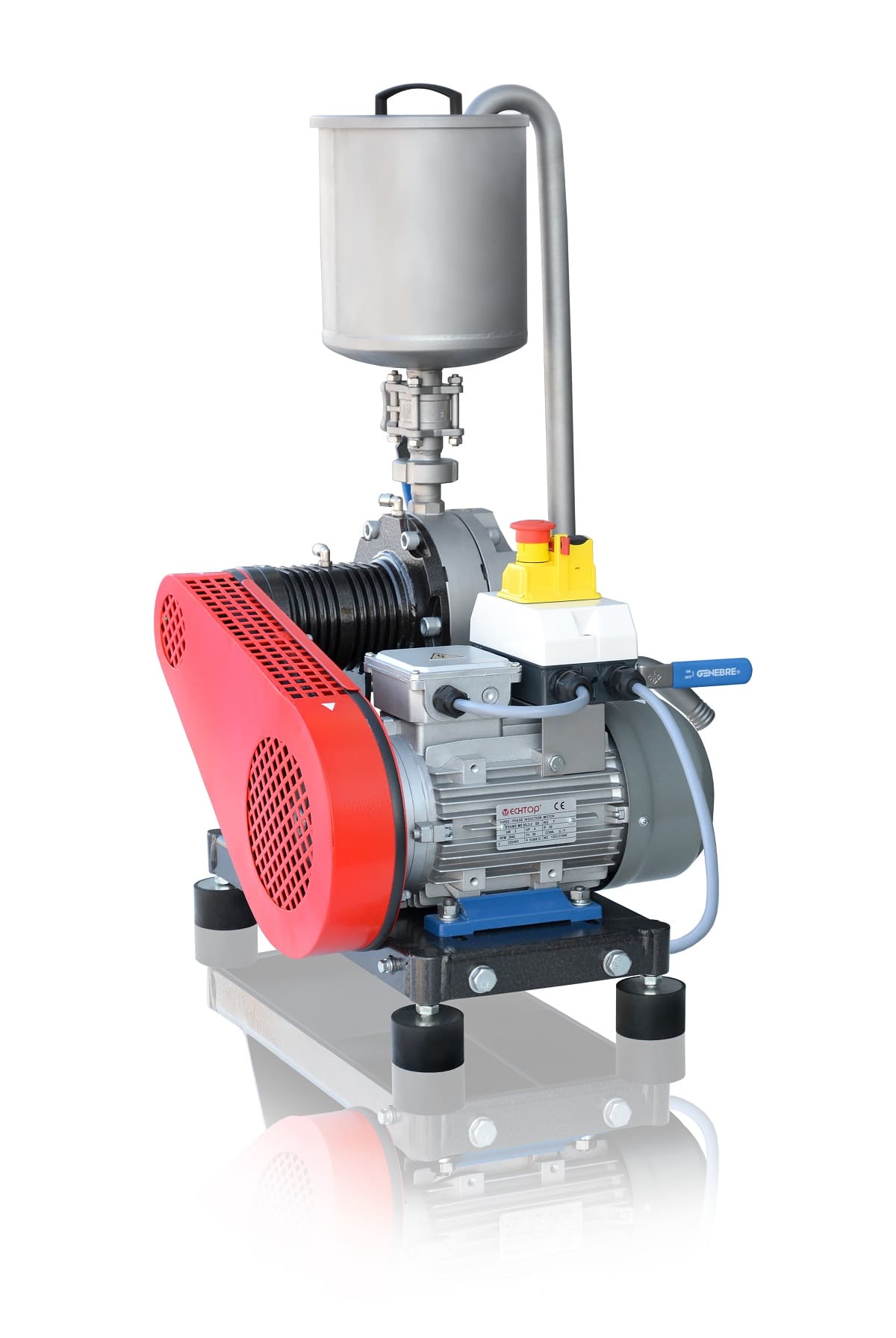
The CLM-100.2 colloid mill brings laboratory-scale homogenization and emulsification to liquid product development. Designed for a lab environment, it supports the preparation, dissolution, and processing of a wide variety of products across different industries – while also producing thick, high-shear-stress slurries for more demanding formulations.
What It’s Used For
The CLM-100.2 is built for laboratories that need reliable, small-batch processing before moving to production scale:
- Preparation and dissolution of liquid products across a range of industrial applications
- Formulation of thick, high-shear slurries, replicating the shear conditions of full-scale production equipment
Its compact laboratory format makes it a practical fit for R&D benches, quality control labs, and formulation testing environments.
Principle of Operation
The CLM-100.2 operates on a rotor/stator system: a rotor and stator built from concentric tool rings – cutters and knives – machined with grooves and holes designed to apply controlled mechanical force to the material being processed.
During operation, the rotor and stator tool rings align coaxially and rotate relative to each other without direct contact, at speeds reaching up to 50 m/s. This contact-free motion is maintained through precisely engineered axial and radial gaps between the two components.
Product flow through the mill:
- Product enters the operating chamber through the stator’s axial bore
- It passes through the rotor/stator system, where it’s exposed to intense mechanical and hydrodynamic forces
- The processed product exits through the radial outlet
As the product moves through the rotor/stator gap, it experiences rapid changes in shear stress, shear force, and flow velocity. This increases the contact surface area between reacting components, speeding up chemical reactions and driving intensive dispersion, emulsification, homogenization, grinding, and pulverization – even at laboratory scale.
Why It Delivers Results
- Speeds of up to 50 m/s – matches the shear intensity of larger production-scale mills, for reliable lab-to-production scale-up
- Compact laboratory design – fits easily into R&D and quality control environments
- Versatile processing capability – handles preparation, dissolution, and processing across multiple industries
- Contact-free rotor/stator operation – consistent, repeatable results with minimal component wear
|
No. |
Parameter |
Value |
| 1 | Capacity of the unit, m3/h (gpm) |
0.1…1 (0.44… 4.4)* |
| 2 | Kinematic viscosity of product, mm2/s (cSt), max |
150 (1.5) |
| 3 | Operating temperature, °С (°F), max |
180 (356) |
| 4 | Maximum pressure, bar (psi) |
6 (87) |
| 5 | Operating volume of product, L (gal) |
5 (1.3) |
| 6 | Shaft seal type |
mechanical |
| 7 | Rotor/stator tooling type |
nozzle |
| 8 | Replaceable knife kit |
optional** |
| 9 | Knife axial gap (preset), mm (in) |
0.2…2 (8·10-3… 8·10-2) |
| 10 | Knife radial gap, mm (in) |
0.25 (10-3) |
| 11 | Knife tip speed, m/s (m/h), max |
50 (112) |
| 12 | Mill shaft and bearing rotation speed, rpm |
6,800 |
| 13 | Electric motor shaft rotation speed, rpm |
3,400 |
| 14 | Drive power, kW |
3.3 |
| 15 | Power supply voltage, V |
customizable |
| 16 | Dimensions, mm (in), max: | |
| – length |
550 (21.7) |
|
| – width |
600 (23.6) |
|
| – height |
850 (33.5) |
|
| 17 | Weight, kg (lbs), max |
75 (165) |
* – the capacity of the unit may change and depends on the resulting product type
- the mill can be used to develop new product formulations;
- the mill handles various types of products;
- compact size;
- design components of the mill wetted portion are made of stainless, chemical resistant steel;
- the mill can have the rotor/stator tooling of various types and the number of operating stages (rings) depending on the type of processed substance and required impact (nozzle, chamber, cone for milling, cone for viscous products);
- the tools can be collapsible, or made from a solid workpiece and various grades of steel depending on the intended purpose of the mill;
- the mill can be operated both indoors and in sheltered outdoor space.