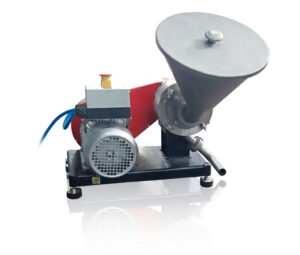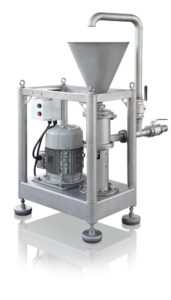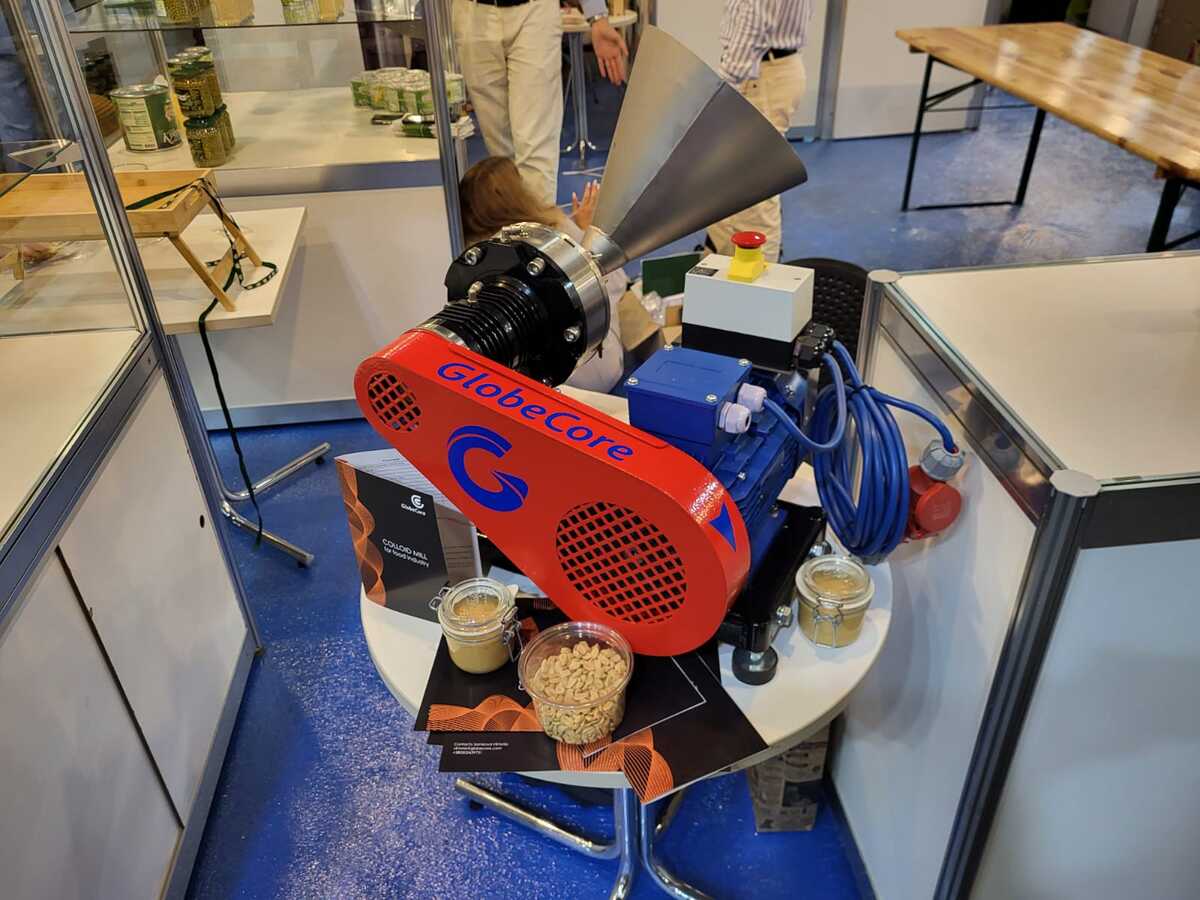
Peanut butter production is a wet-processing application once prepared peanuts release oil and form a flowable paste. At this stage, the principal operations are particle-size reduction, dispersion, and homogenization. A colloid mill can perform this fine wet-milling stage, but it is not a dry peanut grinder or a complete peanut butter line. Cleaning, sorting, roasting or other heat treatment, cooling, skin removal, coarse size reduction, ingredient dosing, bulk mixing, final thermal control, filling, and packaging require separate equipment as specified by the process.
The engineering question is therefore not simply whether a machine can “grind peanuts.” It is whether the prepared feed can pass consistently through a rotor–stator mill and whether that operation produces the required texture, flow behavior, and downstream handling properties. GlobeCore identifies peanut butter production as an application for CLM colloid mills, but model selection and operating conditions must be confirmed with the actual recipe.
What process does peanut butter production require?
Industrial peanut butter manufacture normally contains several distinct operations. The colloid mill belongs only in the part of the line where a prepared peanut paste or flowable formulation requires finer reduction and greater uniformity.
| Operation | Process type | Colloid mill role |
|---|---|---|
| Cleaning, sorting, and foreign-material removal | Raw-material preparation | None; use dedicated upstream equipment. |
| Roasting or another specified heat treatment | Thermal processing | None; temperature treatment requires separate equipment. |
| Cooling and skin removal | Raw-material preparation | None. |
| Initial breaking or coarse grinding | Coarse particle-size reduction | May be required upstream so the feed can enter the mill consistently. |
| Fine wet milling | Particle-size reduction | Reduces particles in a prepared, flowable peanut paste. |
| Dispersion and homogenization | Product-structure development | Distributes particles and ingredients more uniformly through the continuous phase. |
| Ingredient dosing and bulk blending | Formulation and mixing | Normally assigned to metering and mixing equipment; the mill does not replace accurate dosing. |
| Filling and packaging | Downstream handling | None; use dedicated filling and packaging machinery. |
The process is not dry grinding when the feed is an oil-bearing paste. A dry grinder is appropriate when the required product is a free-flowing meal or powder. A colloid mill instead processes material in a liquid or semi-liquid phase. If whole or coarsely prepared peanuts cannot flow into the mill in a controlled manner, upstream crushing and feed conditioning must be addressed first.
How a rotor-stator colloid mill works
Inside a colloid mill, prepared product passes through the working gap between a rotating rotor and a stationary stator. Relative motion between these elements generates intensive shear and turbulence. This action reduces particles and agglomerates while distributing solids through the oil-bearing paste.
The working gap is an important process setting, but it cannot be selected in isolation. A narrower setting may increase processing intensity while also changing load, flow, and product temperature. Feed rate and the number of passes likewise affect the outcome. Recirculation or additional processing cycles should be evaluated only when one pass does not produce the required texture.
Actual results depend on the material, recipe, initial particle size, solids content, viscosity, temperature, feed rate, working gap, and number of processing cycles. These variables also interact. For example, temperature can change viscosity, and viscosity can affect both flow through the working zone and achievable throughput.
What the colloid mill does-and does not do
Functions it can perform
- Fine wet grinding of a prepared, flowable peanut paste;
- reduction of particles and soft agglomerates within the formulation;
- dispersion of solids and recipe components through the continuous phase;
- homogenization that improves the uniformity of the processed paste.
Functions requiring other equipment
- Washing, cleaning, sorting, and removal of foreign material;
- roasting, cooking, sterilization, cooling, or other thermal treatment;
- peeling or removal of peanut skins;
- dry grinding to produce peanut powder;
- accurate weighing, metering, and bulk blending of recipe components;
- product storage, transfer, inspection, filling, and packaging.
A colloid mill should also not be treated as interchangeable with every high-shear device. A mixer primarily combines bulk ingredients. A disperser typically incorporates and distributes solids in a liquid. A high-shear mixer provides intensive mixing and may reduce agglomerates. A homogenizer is selected around a defined homogenization duty and its own operating principle. A ball mill uses grinding media and a different residence-time mechanism. Equipment must be compared against the required product transformation rather than by name alone.
Preparing the feed for stable milling
Stable operation begins upstream. The feed should be free of foreign objects and prepared to a size and consistency that allow controlled entry into the mill. Large pieces or erratic feeding can prevent uniform loading. A paste that does not flow under the planned conditions may require different upstream preparation or a separately engineered feed and transfer arrangement.
The complete formulation matters. Peanut solids, released oil, added oil, sweeteners, salt, stabilizers, and other ingredients can alter viscosity and flowability. The order of addition can also change what reaches the mill. Define whether ingredients are premixed before milling, introduced after milling, or processed through the working zone as part of a validated recipe.
Temperature must be monitored because processing and upstream conditioning can change both product viscosity and texture. The mill should not be assumed to perform cooking, sterilization, or final cooling. Where the recipe has a narrow permissible temperature range, specify separate temperature-control equipment and suitable instrumentation in the line.
Evaluating the CLM-100.3 for peanut butter production
The GlobeCore CLM-100.3 colloid mill is directly relevant for evaluation because GlobeCore documentation lists peanut butter production among food-industry applications of CLM mills. This establishes application relevance, not guaranteed performance for every peanut formulation.
No throughput, final particle size, temperature limit, pressure, or viscosity limit should be inferred from the model name or from a capacity measured with another liquid. A nominal water-based capacity, if shown in equipment documentation, is not a guaranteed peanut butter production rate. The actual formulation may be much more viscous and may respond differently to changes in feed temperature, gap, and number of passes.
Review the broader food-industry colloid mill range when comparing configurations. The CLM-100.3 should be selected only after its documented construction and operating envelope have been checked against the product and installation requirements.
Practical equipment-selection factors
- Formulation: Provide every ingredient, its proportion, and the intended order of addition. Identify abrasive, crystalline, or heat-sensitive components.
- Feed condition: State the initial particle size, consistency, temperature, and whether the feed is already a pumpable paste.
- Required throughput: Define mass flow per hour, batch size, operating schedule, and whether one-pass processing or recirculation is acceptable.
- Target result: Specify measurable particle-size requirements where available, together with texture, mouthfeel, appearance, spreadability, and acceptable variability.
- Viscosity and flowability: Supply measured values at relevant temperatures when possible. Describe any yield behavior or tendency to settle, separate, bridge, or stop flowing.
- Temperature limits: Define the allowable inlet, processing, and discharge temperatures. Identify any heating or cooling available elsewhere in the line.
- Working gap and passes: Treat these as trial parameters rather than fixed assumptions. The required setting and number of cycles must be established with the formulation.
- Cleaning: Describe the cleaning chemicals, temperatures, sequence, frequency, and whether dismantling or an automated cleaning procedure is expected.
- Utilities: Provide the available electrical supply and any separately required water, compressed air, heating, or cooling utilities.
- Integration: Define feed and discharge connections, elevation, piping, valves, transfer equipment, recirculation route, controls, installation space, and access for cleaning and inspection.
Comparing equipment for the required operation
| Equipment | Primary duty | Key limitation in this application |
|---|---|---|
| Colloid mill | Fine wet grinding, dispersion, and homogenization of prepared flowable paste | Not a dry grinder or complete production line. |
| Dry grinder | Production of dry meal or powder | Does not provide wet-paste homogenization. |
| Bulk mixer | Combining and circulating ingredients | May not provide the required fine particle reduction. |
| High-shear mixer or disperser | Intensive mixing and incorporation of solids | Performance must be evaluated against the required particle reduction and texture. |
| Homogenizer | Homogenization under a separately defined operating principle | Not automatically equivalent to rotor–stator wet milling. |
| Ball mill | Media-based fine grinding | Uses a different mechanism and process arrangement. |
Testing and production-line integration
A test with the customer’s actual formulation is the appropriate way to confirm suitability when documented performance data do not cover the recipe. The trial should use representative peanuts, ingredient proportions, feed preparation, and temperature. Record feed rate, gap setting, number of passes, product temperature, and the measured or sensory properties of each sample.
Testing should answer practical questions: Does the feed enter the mill consistently? Is one pass sufficient? Does temperature remain within the recipe limit? Can the discharge be pumped to the next stage? Is the texture acceptable after storage? Can the equipment be cleaned using the plant’s planned method?
The final line may include separate preparation, coarse grinding, dosing, mixing, transfer, holding, temperature-control, inspection, filling, and packaging systems. The colloid mill must be integrated as one wet-processing stage, with connections and controls selected for the actual plant arrangement.
Frequently asked questions
Is peanut butter production a dry- or wet-grinding process?
The colloid-milling stage is wet processing because prepared peanuts form an oil-bearing paste. Dry peanut meal or powder requires dedicated dry-grinding equipment.
Can the CLM-100.3 process whole peanuts?
That capability should not be assumed. The mill requires prepared feed suitable for controlled wet processing. Initial breaking or coarse grinding may be necessary upstream, depending on the feed condition.
Does the mill roast, sterilize, or cool the product?
No. These are separate thermal operations. The mill performs wet particle-size reduction, dispersion, and homogenization; it should not be specified as a roaster, cooker, sterilizer, or cooler.
Can published capacity be used directly for peanut butter?
Not unless the documented capacity is explicitly confirmed for the same formulation and process conditions. A rating obtained with water or another material is not a guaranteed peanut butter throughput.
How is the final texture controlled?
Texture depends on the recipe, initial particle size, solids content, viscosity, temperature, feed rate, working gap, and number of processing cycles. A representative trial is recommended to establish settings.
Is a colloid mill a complete peanut butter production line?
No. It is one wet-processing stage. Upstream preparation and downstream handling require separate equipment selected for the production and food-safety plan.
Discuss the process before selecting the mill
To evaluate the CLM-100.3 without relying on generic assumptions, provide GlobeCore with the complete formulation, feed condition and initial particle size, required throughput, target texture or particle size, viscosity at the relevant temperature, temperature limits, cleaning method, available utilities, and all line-connection requirements. A test using the actual formulation can then confirm whether the colloid mill is the correct stage and identify suitable processing conditions.