A nutmeg crusher must be selected for the required product form. If the target is dry, free-flowing nutmeg powder, use dedicated dry crushing and grinding equipment. If nutmeg is part of a flowable liquid or semi-liquid formulation, a colloid mill can be evaluated for wet particle-size reduction, dispersion, and homogenization. It is not a universal dry spice grinder.
This distinction defines the process. A crusher breaks whole or coarse dry material into smaller pieces. A dry grinder produces meal or powder. A colloid mill processes prepared, flowable material through a high-shear rotor-stator zone. Equipment selection should therefore begin with the feed condition and target product, not the word “crusher.”
What operation must a nutmeg crusher perform?
| Required product | Main operation | Equipment direction |
|---|---|---|
| Broken nutmeg pieces | Coarse dry crushing or cutting | Use a crusher or cutter selected for the required piece size. |
| Dry nutmeg powder | Dry particle-size reduction | Use a purpose-built dry grinder with suitable dust and product-handling provisions. |
| Nutmeg paste or seasoning concentrate | Wet particle-size reduction, dispersion, and homogenization | Evaluate a colloid mill after preparing a flowable feed. |
| Sauce, marinade, or dressing containing nutmeg | Mixing followed by wet dispersion or homogenization as required | Use premixing equipment and evaluate a colloid mill only if the formulation needs intensive wet processing. |
| Emulsion containing nutmeg | Mixing, dispersion, and emulsification | Evaluate the complete formulation and required emulsion properties before selecting equipment. |
Mixing, grinding, dispersion, emulsification, and homogenization are related but different duties. A tank mixer combines ingredients and maintains bulk circulation. A dry grinder reduces dry solids. A disperser helps incorporate and distribute solids in a liquid. A high-shear mixer performs intensive mixing and may break agglomerates. A homogenizer is selected for a defined homogenization duty. A ball mill uses grinding media and a different processing mechanism.
When a colloid mill fits a nutmeg crusher application
GlobeCore documentation lists nutmeg grinding and spice processing among possible CLM colloid mill applications. For engineering purposes, the suitable duty is a wet process: nutmeg must be incorporated into a carrier or formulation that can move consistently through the mill.
Potential products include flowable spice pastes, seasoning concentrates, sauces, marinades, dressings, and other liquid or semi-liquid recipes containing nutmeg. The required operations can include:
- reducing particles in a prepared wet mixture;
- breaking down soft agglomerates;
- dispersing nutmeg solids through the continuous phase;
- homogenizing the processed stream;
- supporting emulsification when the complete recipe contains immiscible liquid phases.
A colloid mill should not be selected merely because it is called a mill. Dry, nonflowing nutmeg powder is not the intended feed for this wet-processing stage.
Rotor-stator wet-processing principle
Inside a colloid mill, prepared product passes through the working zone between a rotating rotor and a stationary stator. Relative movement generates intensive shear and turbulence. For a suitable nutmeg formulation, this action reduces particles or agglomerates and distributes the processed solids through the liquid or paste phase.
The working gap, feed rate, and number of passes affect the process, but no universal setting can be specified for nutmeg. A more intensive gap or an additional pass should not be assumed to guarantee a finer or better product. Changes can also affect flow behavior, throughput, mill load, and product temperature. Representative testing is needed to establish practical settings.
What the colloid mill does not replace
In a food line, the colloid mill is one wet-processing stage. It does not perform:
- raw-material washing, cleaning, sorting, or foreign-material removal;
- shell removal, peeling, or inspection;
- coarse crushing of unsuitable incoming pieces;
- dry grinding to produce free-flowing nutmeg powder;
- accurate weighing and dosing of ingredients;
- bulk premixing or tank-wide circulation;
- cooking, sterilization, cooling, or other validated thermal treatment;
- finished-product storage, filling, or packaging.
These operations require separate equipment where called for by the recipe, production plan, and food-safety system. The mill must be integrated between properly designed upstream preparation and downstream handling stages.
Evaluating the CLM-100.3 for wet nutmeg processing
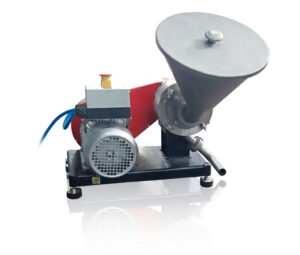
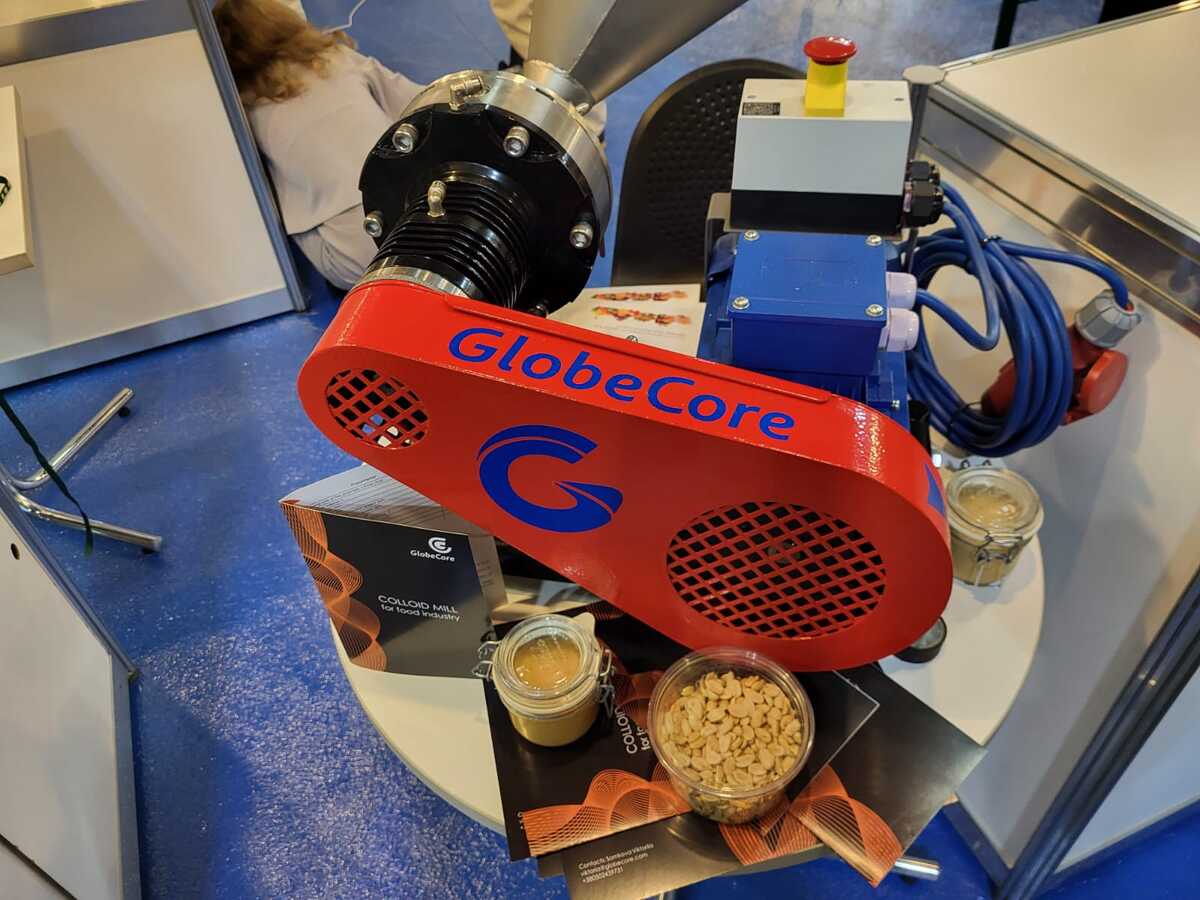
The GlobeCore CLM-100.3 colloid mill is directly relevant for evaluation when the product is a prepared, flowable spice paste or thick slurry. Verified product information describes the CLM-100.3 as a food-industry mill for fine grinding to a paste-like consistency and producing thick slurry under high-shear conditions. Its wetted components are made of stainless, chemically resistant steel.
The documented unit capacity is 0.1 m³/h. This value is not a guaranteed nutmeg-paste throughput. Actual output and processing results depend on the material, recipe, initial particle size, solids content, viscosity, temperature, feed rate, working gap, and number of processing cycles. A nominal capacity stated for the unit, or measured with another material, must not be transferred directly to a specific nutmeg formulation.
The CLM-100.3 should therefore be considered only after the process duty has been defined. Buyers can also review the food-industry colloid mill range and the related guide to commercial nutmeg paste processing.
Preparing nutmeg feed for stable wet milling
Initial size and feed consistency
Do not assume that whole nutmeg can be fed directly. Incoming material must be prepared to enter the working zone consistently. Oversized pieces, dry clumps, and foreign objects may require separate crushing, screening, or inspection. The acceptable preparation method should be confirmed by a trial rather than inferred from the spice name.
Flowability, solids content, and viscosity
The formulation must remain flowable at the mill inlet and through the intended discharge route. Nutmeg content, carrier phase, dissolved ingredients, suspended solids, and addition order can all change viscosity and feed behavior.
Provide measured viscosity at the relevant temperature whenever possible. Also report practical problems such as bridging, settling, phase separation, or loss of flow. A nonflowing mixture may require different premixing, conditioning, or transfer equipment.
Temperature
Temperature can affect viscosity, ingredient behavior, and final texture. It should be measured during testing and production. The colloid mill is not a cooker, sterilizer, or cooler. If the recipe has strict temperature limits, separate heating or cooling equipment and appropriate instrumentation must be designed into the line.
Working gap, passes, and acceptance criteria
Define the target in measurable or observable terms before testing. Depending on the product, acceptance criteria may include particle size, texture, mouthfeel, visible specks, flowability, dispersion uniformity, or stability during the specified evaluation period.
A useful trial record includes:
- complete formulation and ingredient-addition sequence;
- nutmeg preparation and initial particle condition;
- solids content and viscosity at a stated temperature;
- inlet and discharge temperatures;
- feed rate and observed flow stability;
- working-gap setting;
- number of passes or recirculation cycles;
- final texture, particle-size result, and handling behavior.
Testing with the customer’s actual formulation is recommended whenever documented data do not confirm the required result. This is the practical way to determine whether one pass is adequate or controlled recirculation is needed.
Nutmeg crusher equipment-selection checklist
- Define the product form: coarse pieces, dry powder, paste, sauce, concentrate, suspension, or emulsion.
- Identify the unit operation: mixing, dry crushing, dry grinding, wet particle-size reduction, dispersion, emulsification, or homogenization.
- Describe the feed: initial size, moisture condition, temperature, preparation method, and flowability.
- Provide the full recipe: every ingredient, proportion, solids content, carrier phase, and addition sequence.
- Set the production duty: required throughput, batch size, operating schedule, and whether recirculation is acceptable.
- Specify the target: particle size, texture, visual uniformity, mouthfeel, and acceptable variation.
- State process limits: viscosity range, temperature limits, and any heat-sensitive ingredients.
- Define cleaning: cleaning method, chemicals, temperatures, frequency, inspection access, and allergen-control requirements.
- List utilities: available electrical supply and any water, compressed air, heating, or cooling services needed by the complete line.
- Plan integration: inlet and outlet connections, piping, valves, transfer equipment, tanks, controls, sampling points, and installation space.
Frequently asked questions
Can the CLM-100.3 make dry nutmeg powder?
It should not be specified as a general dry nutmeg grinder. Dry, free-flowing powder requires equipment designed for dry particle-size reduction. The CLM-100.3 is relevant to evaluation for a prepared, flowable paste or thick slurry.
Can a colloid mill accept whole nutmeg?
This should not be assumed. The feed must enter the working zone consistently. Separate coarse crushing, screening, or conditioning may be needed upstream, depending on the material.
Does a colloid mill replace a mixer?
No. A mixer provides bulk blending and vessel circulation. A colloid mill applies intensive processing to the stream passing through its rotor–stator zone. Many recipes require both stages.
Is emulsification always part of nutmeg processing?
No. Emulsification is required only when one immiscible liquid phase must be distributed through another. A simple nutmeg suspension or paste may require particle-size reduction, dispersion, and homogenization without creating an emulsion.
How many processing passes are required?
There is no universal answer. The number of passes depends on the formulation, initial particle size, solids content, viscosity, temperature, feed rate, working gap, and target result. Use representative testing to determine whether one pass or recirculation is appropriate.
Is the CLM-100.3 a complete spice-processing line?
No. It is one wet-milling stage. Preparation, crushing, dosing, mixing, thermal processing, storage, filling, and packaging require separate equipment when included in the production process.
Define the process before requesting equipment
To evaluate a nutmeg crusher application, provide GlobeCore with the complete formulation, feed condition and initial particle size, required throughput, target texture or particle size, viscosity at the relevant temperature, temperature limits, cleaning method, available utilities, and all line-connection requirements. With these data and a test using the actual formulation, the engineering team can determine whether the CLM-100.3 is an appropriate wet-processing stage.