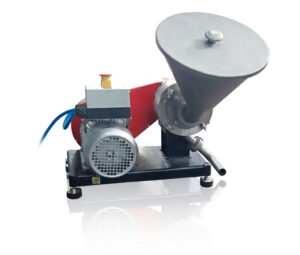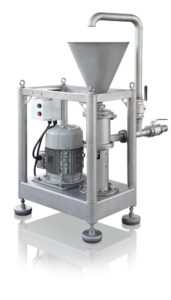
A nutmeg grinder is often searched for by food producers that need a consistent spice ingredient at scale. The right equipment depends on the final product. For dry, free-flowing nutmeg powder, use a purpose-built dry grinding system. For a liquid or semi-liquid seasoning, sauce base, or spice paste in which nutmeg is blended with a carrier phase, an industrial colloid mill can provide fine wet grinding, dispersion and homogenisation in one process step.
This distinction matters. A colloid mill is not a substitute for every dry spice grinder. It is designed for wet-process applications where particles are processed in a liquid phase and a stable, uniform product is required.
When is a colloid mill suitable for a nutmeg grinder application?
A colloid mill may be suitable after the nutmeg has been combined with a compatible liquid phase, such as water, oil, syrup, vinegar solution, or another formulation-specific carrier. Typical applications include:
- wet spice pastes and seasoning concentrates;
- marinades, dressings and sauce bases containing finely dispersed spices;
- oil-based flavour systems and emulsified food products;
- pilot batches and production batches that require repeatable texture.
In these applications, the objective is not simply to break a whole nutmeg into powder. It is to reduce particles while distributing them evenly through the recipe and producing a homogeneous, pumpable mixture.
How wet grinding works
In a colloid mill, product passes through the adjustable gap between a rotating rotor and a stationary stator. The rotor-stator action creates intensive shear and turbulence, helping to reduce agglomerates and disperse solid particles through the carrier phase.
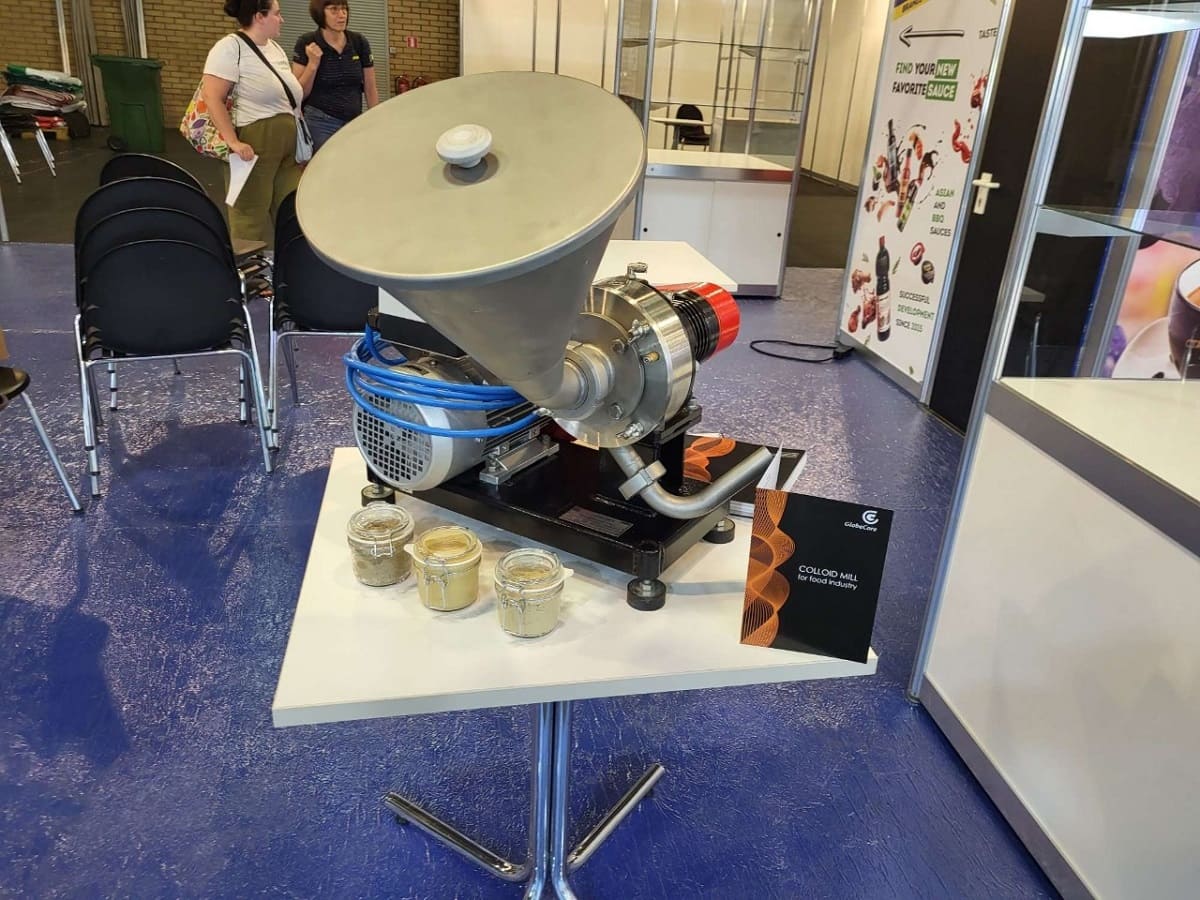
For a wet spice formulation, the mill can contribute to three linked results:
- Grinding: reducing particles in the prepared mixture;
- Dispersion: distributing spice solids more evenly in the liquid phase;
- Homogenisation: improving consistency from batch to batch.
Results depend on the formulation, initial particle size, viscosity, feed rate, temperature, required texture and the number of passes. A production test with the actual recipe is the reliable way to select settings and confirm the result.
Dry nutmeg powder vs. wet spice paste
| Production target | Recommended equipment approach |
|---|---|
| Dry, free-flowing ground nutmeg | Select a dedicated dry grinding solution; a colloid mill is not the primary choice. |
| Nutmeg dispersed in a sauce, marinade or oil-based paste | Evaluate a colloid mill after the solids are pre-mixed with the carrier phase. |
| Stable, fine suspension or emulsion containing spices | Evaluate rotor-stator wet grinding and homogenisation, with trials on the finished formulation. |
Giving this information early helps purchasing and process teams compare like with like. A request for a “nutmeg grinder” can describe two very different processes, and the product form determines the correct technology.
What to specify when requesting a mill
To assess whether a GlobeCore colloid mill fits a wet spice process, prepare the following information:
- the complete recipe, including the liquid carrier and the percentage of solids;
- target throughput per hour and batch size;
- required particle-size range, texture and visual appearance;
- product viscosity and whether the material must remain pumpable;
- temperature limits and any heating or cooling requirements;
- food-contact material requirements and cleaning procedure;
- whether a single pass or recirculation is acceptable.
For food-industry applications, see the CLM-100.3 colloid mill. Capacity and final dispersion must be confirmed against the actual material, rather than assumed from water-based ratings.
How to choose a commercial nutmeg grinder for a wet process
Start with the process, not the keyword. If your product is a dry ground spice, choose dry grinding equipment. If it is a wet, formulated product, ask whether the process needs particle reduction only or also dispersion and homogenisation. A colloid mill is most relevant when those functions must occur together and the output must be consistent enough for downstream filling, pumping or further mixing.
GlobeCore engineers can evaluate a recipe and recommend a suitable configuration based on the required throughput and product characteristics. See a food-industry colloid mill application before submitting an enquiry.
Frequently asked questions
Can a colloid mill grind whole, dry nutmeg?
No. A colloid mill should not be presented as a general dry-nutmeg grinder. It is intended for wet-process mixtures. For dry nutmeg powder, use dedicated dry grinding equipment.
Can a colloid mill process nutmeg in a sauce or seasoning paste?
Potentially, yes. When nutmeg is incorporated into a liquid or semi-liquid recipe, a colloid mill can be evaluated for wet grinding, dispersion and homogenisation. Confirm suitability with a trial using the actual formulation.
What determines the final texture?
The final result depends on the formula, rotor-stator gap, feed rate, viscosity, temperature and number of processing cycles. Share these requirements when requesting equipment selection support.
Talk to GlobeCore about your formulation
If you are evaluating a nutmeg grinder for a commercial wet spice process, send the recipe parameters, desired output and hourly capacity. GlobeCore can help determine whether a colloid mill is the appropriate processing stage for your application.