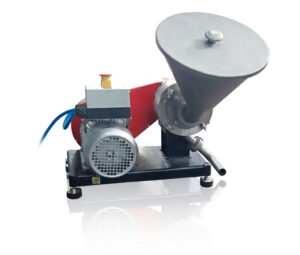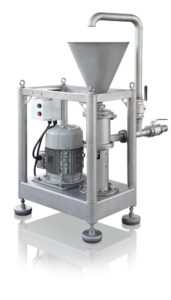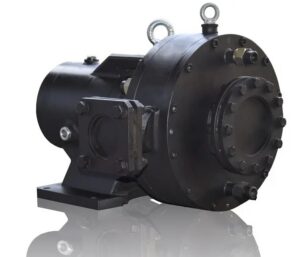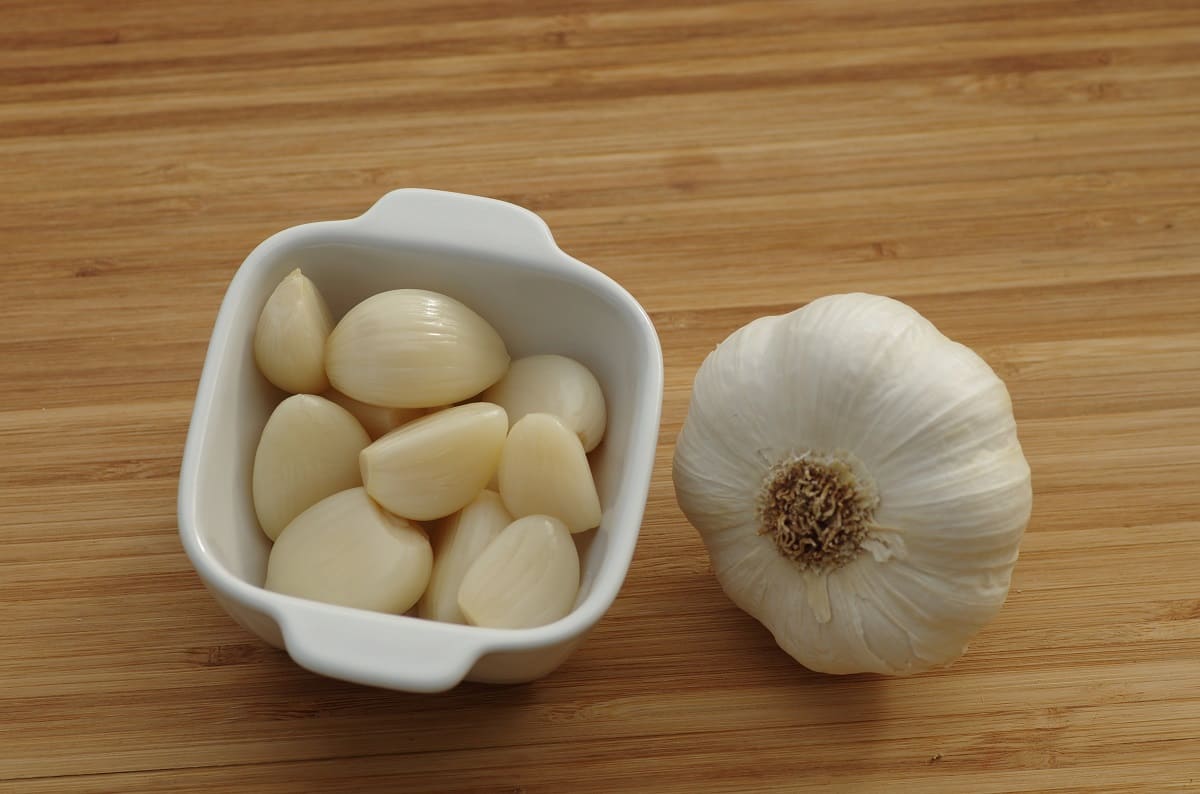
A garlic paste making machine for industrial food production is a wet-process grinder and homogenizer. In GlobeCore applications, a stainless-steel colloid mill reduces a prepared garlic mixture and creates a more uniform paste. It handles the fine-grinding stage; washing, peeling, recipe dosing, heat treatment, and packaging remain separate operations in the production line.
What is a garlic paste making machine?
A garlic paste making machine is equipment used to reduce prepared garlic in a liquid or semi-liquid formulation to the required texture. For industrial wet processing, a rotor–stator colloid mill can act as the main garlic grinding machine. The product moves through a narrow working gap where intensive shear breaks down particles and distributes them through the carrier phase.
The result is a finely divided, more homogeneous paste suitable for transfer to the next validated production step. Actual texture depends on the recipe, feed condition, viscosity, temperature, throughput, mill setting, and number of passes. A trial with the customer’s formulation is therefore more reliable than selecting equipment from a generic capacity figure alone.
What the colloid mill does – and does not do
The colloid mill is one processing stage, not a complete garlic processing line. Defining this boundary prevents an equipment specification from assigning unsupported functions to the mill.
| Process step | Role of the colloid mill |
|---|---|
| Washing and peeling | Not performed by the mill; prepare and inspect the garlic upstream. |
| Recipe preparation | Ingredients and any carrier phase are dosed according to the validated formulation. |
| Fine grinding | The mill reduces particles in the prepared, flowable mixture. |
| Dispersion and homogenization | Rotor–stator action helps distribute solids and improve consistency. |
| Heat treatment | Specified separately when required by the product and food-safety plan. |
| Filling and packaging | Handled by downstream equipment selected for the finished product. |
This scope makes a GlobeCore colloid mill relevant when the required stage is fine wet grinding and homogenization. It should not be presented as a washer, peeler, cooker, or packaging machine.
How colloid milling produces uniform garlic paste
Inside a colloid mill, the product passes between a rotating rotor and a stationary stator. The relative speed of these working elements creates shear and turbulence. This action reduces agglomerates and distributes garlic particles through the mixture.
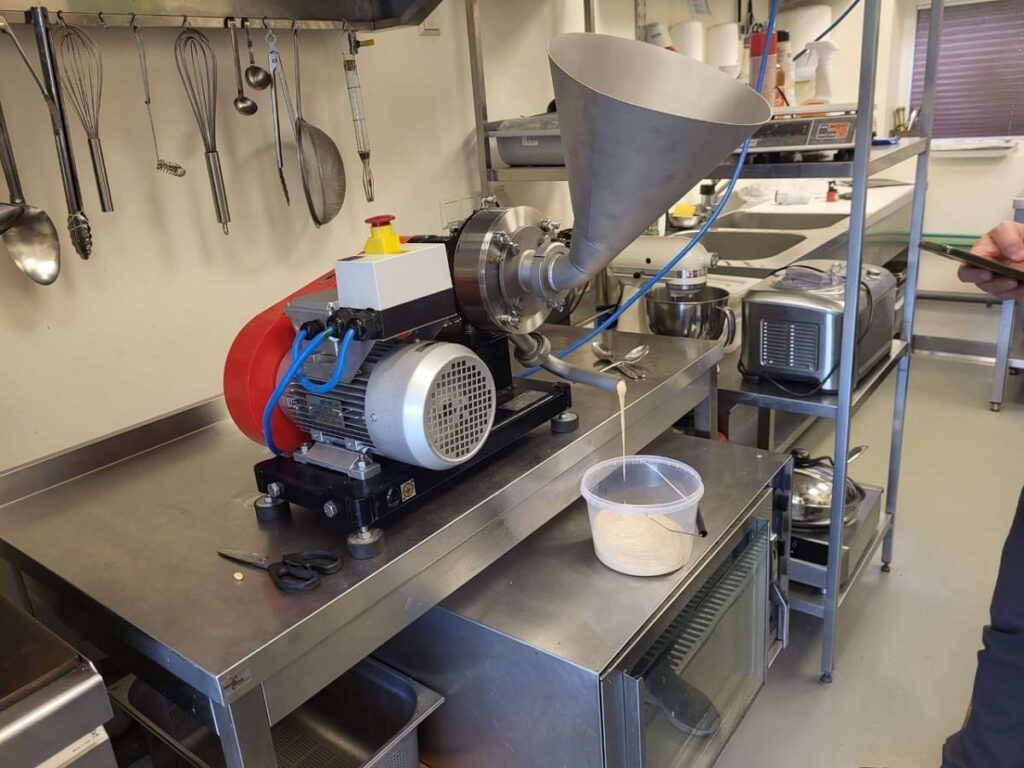
The garlic feed must be suitable for wet processing and able to enter the mill consistently. Oversized pieces, foreign material, or a formulation that cannot flow may require upstream preparation. The target is not simply “smaller garlic”; it is a repeatable paste whose texture and handling properties fit the next operation.
7 selection factors for an industrial garlic paste machine
Provide these seven inputs before selecting a garlic paste making machine:
- Production rate: state the required kilograms per hour and whether the process is continuous or batch-based.
- Complete formulation: identify garlic content, liquid carrier, oil, salt, stabilizers, and other ingredients that affect flow.
- Feed condition: describe the size, temperature, and consistency of the prepared material entering the mill.
- Target texture: specify the acceptable particle range, visual appearance, mouthfeel, and batch-to-batch consistency.
- Viscosity and pumpability: confirm whether the feed and finished paste can be moved through the intended piping and transfer system.
- Temperature limits: define the acceptable product temperature and any requirement for controlled cooling or heating elsewhere in the line.
- Cleaning and installation: provide the cleaning procedure, food-contact requirements, available utilities, layout, and connection details.
For an available food-industry configuration, review the CLM-100.3 colloid mill. Final model, settings, and throughput should be confirmed against the actual garlic formulation.
Equipment comparison
| Equipment | Best fit | Important limit |
|---|---|---|
| Colloid mill | Fine wet grinding, dispersion, and homogenization of a prepared flowable mixture. | Not intended to replace every upstream or downstream process step. |
| Dry grinder | Dry garlic flakes or other free-flowing material intended to become powder. | Does not provide wet-process homogenization. |
| General mixer | Combining ingredients and maintaining bulk uniformity. | May not provide the fine particle reduction required for a smooth paste. |
The product form decides the technology. A dry powder process and a wet garlic paste process should not be specified as if they were interchangeable. For other wet food applications, compare GlobeCore’s examples for hummus production and mustard production.
Food-contact construction and line integration
GlobeCore food-industry colloid mills use stainless steel on product-contact surfaces. This supports cleaning and helps avoid unwanted effects on the finished product’s odor, color, or taste. The complete installation still needs a documented sanitation procedure, inspection schedule, hazard analysis, and controls appropriate to the product and facility.
In the United States, food processors can consult the official FDA overview of 21 CFR Part 117 requirements for current good manufacturing practice and preventive controls. Local rules and the plant’s validated food-safety plan govern the complete line; the mill is one component within that system.
Integration data should cover feed connection, discharge arrangement, transfer pump, recirculation if required, installation space, electrical supply, and access for inspection. Sharing this information early reduces assumptions during equipment selection.
Frequently asked questions
Can a colloid mill make garlic paste?
Yes. A colloid mill can be evaluated as the fine-grinding and homogenizing stage for a prepared, flowable garlic mixture. Suitability and settings should be confirmed with the actual recipe.
Can the machine process whole unpeeled garlic?
No such capability should be assumed. Washing, peeling, inspection, and initial preparation belong upstream. The mill receives prepared feed suitable for wet grinding.
What determines garlic paste consistency?
Consistency depends on formulation, feed size, viscosity, temperature, rotor–stator setting, feed rate, and number of passes. Define the acceptable finished texture before equipment selection.
Is a colloid mill the same as a complete garlic processing machine?
No. It performs fine grinding, dispersion, and homogenization. A complete production line may also require preparation, dosing, heat treatment, transfer, inspection, filling, and packaging equipment.
How should a buyer request a quotation?
Send the complete recipe, feed condition, required hourly output, target texture, temperature limits, cleaning method, and line-connection details. These inputs allow the engineering team to evaluate an appropriate configuration.
Request equipment selection
A well-specified garlic paste making machine starts with the product, not a generic equipment label. Send GlobeCore the actual formulation, required capacity, and target paste characteristics. The engineering team can then determine whether a food-industry CLM colloid mill is the correct processing stage and how it should connect to the rest of the line.