The history of mustard extends back a couple of millennia. Today it is one of the most popular spices used in cuisines around the world. In general, mustard is a mixture of mustard seeds, water, vinegar and various additives. The taste of mustard depends on the additives used and the type of plant seeds – white, black, brown (saperda/Indian) or Abyssinian mustard.
Regional Varieties Behind Mustard Production Traditions
In Europe, the most popular is “Dijon” mustard, made with white wine and black mustard seeds and produced since the 14th century. The most liquid mustard is “American,” made with white mustard seeds and a lot of sugar. “Bavarian” mustard is prepared with coarse-grained seeds and caramel syrup. “English” mustard is made by mixing crushed seeds with apple juice or cider. In Italy, “Fruit” mustard is popular, prepared with whole or large pieces of apple, orange, pear and other fruits added to mustard powder, white wine, honey and spices. Finally, there is the hot, strong “Saperda mustard,” whose mustard production technology will be discussed in detail below.
Stages of Mustard Production
The production of mustard consists of the following stages:
- Preparing saline solution
- Preparing sugar syrup
- Preparing marinade
- Preparing the mustard itself
- Preparing the Raw Materials
Components (mustard powder, peanut flour, salt and sugar) are pre-sieved through sieves with a mesh size of about 1mm. The sieves are equipped with magnets for trapping large lumps of mustard powder and peanut flour, which then require additional crushing. This additional crushing improves the “swelling” properties essential to quality mustard production.
Sugar syrup is prepared from sugar and water in a proportion of nine to five, boiled for half an hour to prevent the development of mucosal bacteria.
The saline solution is prepared from salt and water in equal proportions (one to one), brought to a boil, and then filtered.
A marinade is a day-old solution of water, vinegar and spices (pepper, cloves, bay leaf, cardamom, and others). If required by the recipe, garlic extract is prepared separately over a period of five days.
The Two-Stage Mustard Mixing Process
When all components are ready, the mustard production process follows two stages: first, mixing the main ingredients; second, adding the recipe components.
During the mixing process, water heated to 80°C is delivered into a special mixing tank and continuously stirred, after which mustard powder and half of the marinade are added. The mixture is continuously stirred for 25-30 minutes. This is generally done using paddle-type mixers, though the most efficient mixing is achieved by repeatedly running the mixture through a homogenizer or colloid mill. The mixture is then left to sit for a few hours to launch the fermentation process.
Into the resulting mustard paste, continuously stirred, are added: vegetable oil, saline solution, sugar syrup, and the remaining marinade. This mixing stage lasts for an hour, during which the mustard is passed through a homogenizer (colloid mill) to obtain a high-quality, uniform product.
Standard Equipment for a Mustard Production Line
As a general rule, a mustard production line is equipped according to the customer’s requirements. However, there is a “basic” set of equipment typically installed:
- Vibro screen for sieving mustard powder. Mesh size does not exceed 1.5mm, with an optimal oscillation amplitude of about 10mm and an oscillation frequency of about 500-600 oscillations per minute.
- Stainless steel tanks for preparing saline solution, sugar syrup and marinade, equipped with heaters for boiling. Tanks for syrup and saline solution are also equipped with low-RPM mixers.
- Filters placed between the solution tanks and the homogenizer, which delivers the mixture into the mustard preparation machine. These filters remove foreign matter and large particles.
- The mustard preparing machine – generally a vertical container with a water-steam heating circuit, equipped with a blade- or rake-type agitator.
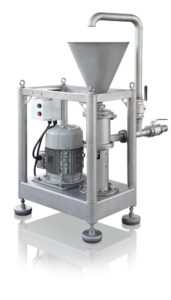
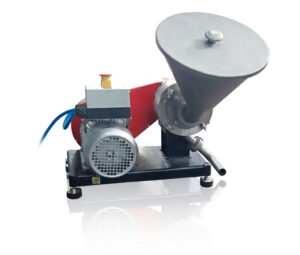
- Crusher-homogenizer, an integral part of the production line. Usually a rotary homogenizer or colloid mill (such as those produced by GlobeCore), its main purpose is to crush the mustard mass into a fine, homogeneous state while also acting as a transfer pump.
Storage After Mustard Production
Packaged mustard is stored in dark, dry rooms at a temperature not exceeding +10°C. Shelf life varies from 45 days during the hot season to up to 90 days in the cold season.