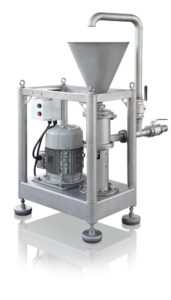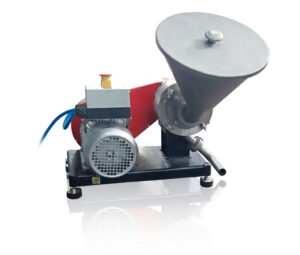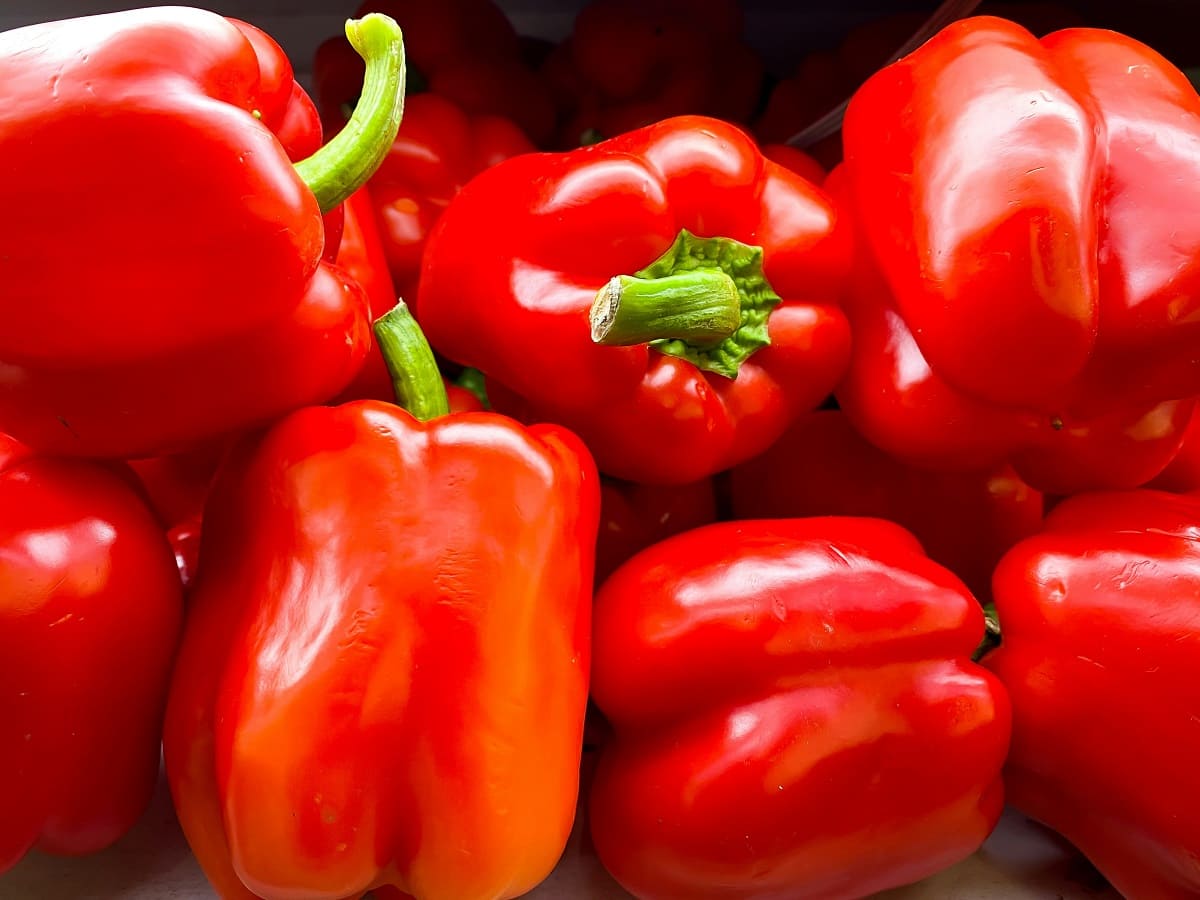
An industrial pepper grinder must be selected by the required product, not by the word “grinder.” Producing dry pepper powder or granules is a dry particle-size-reduction duty and requires appropriate dry-grinding equipment. Producing chili paste, pepper puree, or another pumpable pepper formulation is a wet-processing duty that may include particle-size reduction, dispersion, and homogenization. A colloid mill belongs to the second category.
GlobeCore documentation identifies spice grinding, including black pepper, and chili pepper milling among CLM colloid-mill applications. That does not mean a CLM mill should receive dry peppercorns directly or that it will replace every machine in a pepper-processing line. The formulation and feed condition must first be checked.
Is a colloid mill the right pepper grinder?
| Required product | Main operation | Equipment direction |
|---|---|---|
| Dry pepper powder | Dry particle-size reduction | Use a dry grinder designed for spices and powder handling. |
| Coarse dry pepper granules | Dry crushing and classification | Use a dry crusher or grinder with suitable screening or classification. |
| Pumpable pepper paste or puree | Wet particle-size reduction and homogenization | A food-industry colloid mill may be evaluated after feed preparation. |
| Liquid sauce containing pepper solids | Mixing, dispersion, wet size reduction, and possibly homogenization | Use a mixer for bulk blending; evaluate a colloid mill as a separate high-shear wet-processing stage. |
| Stable oil-and-water pepper sauce | Mixing and emulsification, with possible solids reduction | The recipe may require both premixing and colloid milling; formulation testing is necessary. |
The first engineering question is therefore simple: Will the pepper enter the machine as a dry, free-flowing solid or as part of a flowable wet formulation? A colloid mill is not a substitute for a conventional dry pepper grinder.
What a food colloid mill does
A colloid mill is used for wet grinding and homogenization. Product passes through the mill’s rotor-stator working zone, where high shear acts on a liquid or paste-like feed. Depending on the formulation, this stage can reduce suspended solids, distribute ingredients more uniformly, and improve the consistency of a slurry or paste.
For pepper processing, the practical objective could be a smoother chili paste, a more uniform pepper suspension, or a consistent sauce base. The process result is not determined by the mill model alone. It depends on the material, recipe, initial particle size, solids content, viscosity, temperature, feed rate, working gap, and number of processing cycles.
What the colloid mill does not do
A colloid mill is one wet-processing stage, not a complete food-production line. It should not be presented as performing the following separate operations:
- washing or sorting peppers;
- removing stems, seeds, or foreign material;
- peeling, cooking, or thermal treatment;
- coarse dry crushing of whole peppercorns;
- bulk ingredient storage and batch weighing;
- sterilization or aseptic processing;
- filling, sealing, labeling, or packaging.
These duties require dedicated upstream or downstream equipment. A complete line may include inspection, washing, cutting or pre-crushing, premixing, pumping, colloid milling, thermal processing, holding, and packaging stages selected for the actual product.
CLM-250.3 as a candidate for wet pepper processing
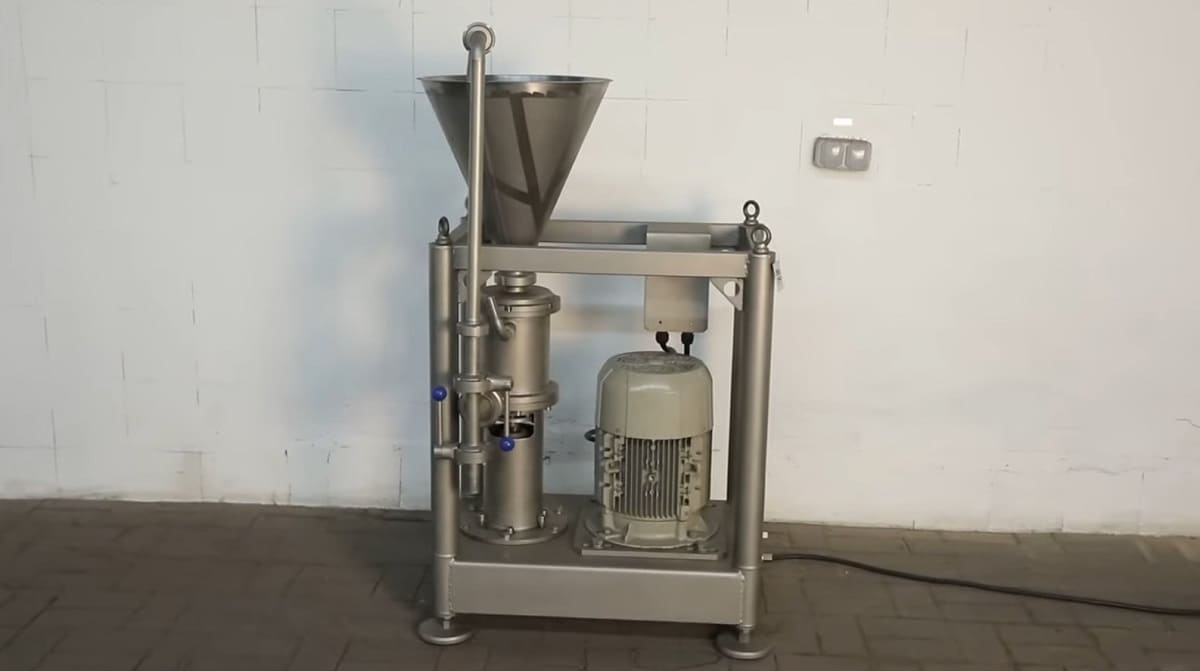
The GlobeCore CLM-250.3 colloid mill is listed in GlobeCore’s food-industry range. GlobeCore technical material also identifies black-pepper spice grinding, large-pepper grinding, chili pepper milling, and chili paste making as colloid-mill applications.
These documented applications make the CLM-250.3 relevant for evaluation when the intended product is a flowable pepper slurry, paste, puree, or sauce base. They do not establish that the model can process every pepper recipe, accept whole dry peppercorns, or deliver a specified output particle size or throughput for an untested formulation.
No formulation-specific CLM-250.3 capacity, guaranteed pepper particle size, temperature limit, pressure limit, or utility requirement should be inferred from a nominal model designation. Testing with the customer’s actual formulation is the appropriate way to confirm performance when documented application data do not establish the required result.
Feed preparation for wet pepper milling
Create a controllable, flowable feed
Before wet milling, the recipe must be capable of reaching and passing through the processing zone at a controlled rate. Whole peppers, large fibrous pieces, or a mixture that bridges in the feed system may require cutting, crushing, maceration, or premixing in separate equipment.
The liquid phase and solids loading influence flowability. Adding liquid is not merely a mechanical decision: it changes the recipe, flavor concentration, preservation system, and downstream thermal duty. Food technologists and process engineers should therefore define feed preparation together.
Remove material that should not enter the mill
Foreign objects and unintended hard contaminants must be removed upstream. Stems, seeds, skins, and fibers should be retained or removed according to the product specification, not simply left for the mill to resolve. The allowable feed size and contaminant-control arrangement must be confirmed with the equipment supplier.
Use a mixer for premixing
A colloid mill is not automatically an efficient bulk mixer. If water, oil, vinegar, salt, stabilizers, or other ingredients must be incorporated into a batch, a separate vessel and mixer may be needed to establish a uniform, feedable premix. The mill then performs the specified wet size-reduction, dispersion, emulsification, or homogenization duty.
Variables that control the final texture
- Initial particle size: Coarse feed may need an upstream reduction step before colloid milling.
- Solids content: The amount and character of pepper solids influence flow behavior and processing load.
- Viscosity: Viscosity affects feeding, circulation, pressure loss, and practical throughput.
- Temperature: Feed temperature influences viscosity and must remain within the recipe’s quality and safety limits as well as confirmed equipment limits.
- Feed rate: Throughput must be validated with the actual recipe. A capacity measured with another material is not a guarantee for pepper paste.
- Working gap: Gap selection influences processing intensity and must remain within the manufacturer’s operating instructions.
- Number of passes: Recirculation or multiple passes may change texture, but each additional cycle adds processing time and can affect temperature.
A useful trial records all these variables rather than reporting only the mill setting. Samples should be assessed against measurable acceptance criteria such as the required particle-size distribution, texture, viscosity, phase stability, or sensory standard.
How the pepper grinder fits into the production line
- Define the finished product. Specify whether it is a dry spice, coarse seasoning, wet paste, puree, suspension, or emulsion.
- Prepare the raw material. Inspect, wash, trim, and pre-reduce it with separate equipment as required.
- Prepare the formulation. Meter and premix ingredients in an appropriate vessel when the recipe requires it.
- Feed the colloid mill. Provide a flowable, controlled feed compatible with the selected mill and line connections.
- Evaluate the discharge. Sample the product and determine whether another pass is justified.
- Complete downstream processing. Thermal treatment, holding, filling, and packaging remain separate line operations.
Engineers comparing options can review GlobeCore’s broader food-industry colloid mill range and the colloid mill equipment overview. Equipment for bitumen emulsion or bitumen modification belongs to different process systems and should not be treated as a food pepper-processing line.
Practical equipment-selection checklist
- Is the required output dry or wet?
- Which operation is primary: mixing, dry grinding, wet particle-size reduction, dispersion, emulsification, or homogenization?
- What are the feed material, recipe, initial particle size, and solids content?
- Is the prepared feed pumpable and stable enough for controlled delivery?
- What viscosity range and temperature range are expected during operation?
- What throughput must be sustained with this specific formulation?
- What texture, particle-size distribution, or stability criterion defines acceptance?
- Will the process use one pass or recirculation?
- How will product-contact areas be cleaned, inspected, and returned to service?
- Which utilities, controls, inlet and outlet connections, pumps, tanks, and valves are available?
- What upstream contaminant removal and coarse-size reduction are required?
Cleaning and changeover considerations
Pepper products can contain oils, pigments, fine solids, skins, and fibers. The cleaning method should therefore be defined before equipment purchase. Confirm how the product-contact zone is accessed, how cleaning fluid is supplied and discharged, how trapped material is detected, and whether the proposed procedure is compatible with the recipe and plant sanitation program.
For facilities processing more than one pepper variety or products with allergens, the validation plan should address carryover and cross-contact. Cleaning time also belongs in the throughput calculation because production capacity is not only the instantaneous flow through the mill.
Frequently asked questions
Can the CLM-250.3 replace a dry pepper grinder?
No such conclusion should be made. A dry grinder is selected for powder or granule production. The CLM-250.3 should be evaluated as a wet-processing colloid mill for a flowable food formulation.
Can whole peppercorns be fed directly into a colloid mill?
Direct feeding should not be assumed. The maximum acceptable feed condition and particle size must be confirmed, and upstream crushing or premixing may be required.
Does a colloid mill also mix the complete batch?
It creates high shear in its processing zone, but it does not automatically replace a batch tank and mixer used for ingredient incorporation, solids wetting, and bulk uniformity.
Will one pass produce the required texture?
That cannot be guaranteed without formulation-specific evidence. Working gap, feed rate, initial particle size, solids content, viscosity, temperature, and the number of cycles all influence the result.
Is a published nominal capacity valid for pepper paste?
Not automatically. Capacity obtained with water or another reference material must not be treated as guaranteed pepper-paste throughput. The customer’s actual recipe should be tested.
Discuss the application before selecting the mill
For an engineering review of the CLM-250.3, provide GlobeCore with the formulation, feed condition, required throughput, target texture or particle size, solids content, viscosity, temperature limits, intended number of passes, cleaning method, available utilities, and line-connection requirements. A sample trial with the actual formulation is recommended when the required result is not already confirmed by documented data.