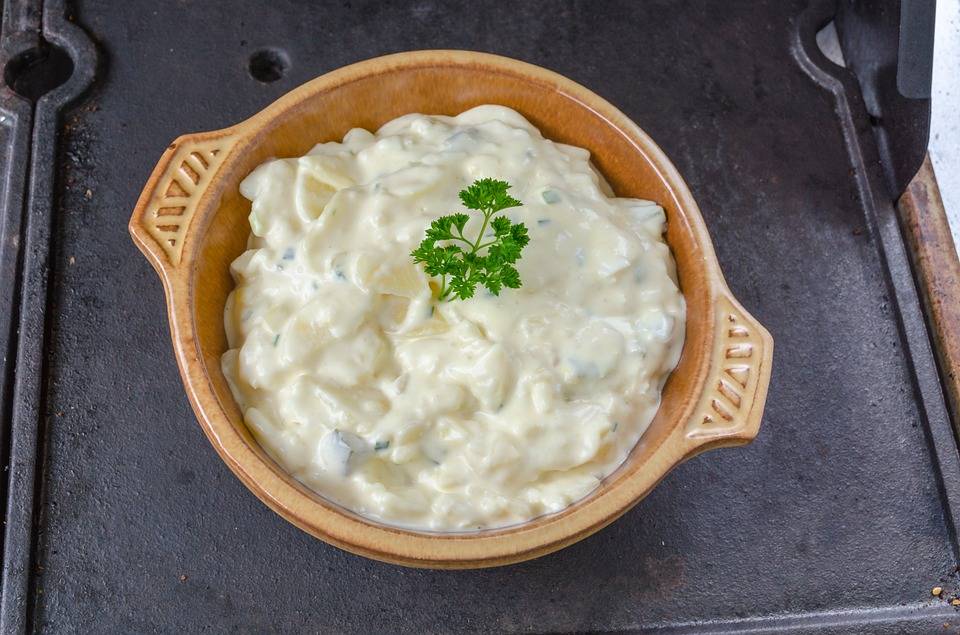
There is a legend about the origin of mayonnaise. It says this sauce was invented by a chef of the French garrison, besieged by the British on the island of Menorca in the city of Mahon. The besieged experienced food shortages – there were only olive oil and turkey eggs available, and the officers were fed solely on fried eggs. Then the French commandant’s personal chef thoroughly grated egg yolks with sugar and salt, mixed it all with olive oil, and finally added lemon juice to the mixture. Thus, classic mayonnaise was created. This wonderful sauce quickly gained recognition and became known as “mahon sauce,” or “mayonnaise.”
However, the Spanish insist on their own authorship, arguing that the French usurped the glory of their “ali-oli” sauce, popular in Southern Europe since the time of Virgil.
In the early 19th century, a French chef made mayonnaise with mustard, giving it a delicious, piquant taste. Besides flavor, mustard – being an excellent emulsifier – improved the sauce’s durability during long-term storage. This mustard-based sauce became known as “Provençal sauce from Mahon,” or the more familiar “Provence” mayonnaise.
What Defines Modern Mayonnaise Production
Today there are many mayonnaise recipes with different ingredient proportions, but the determining factor of the product is fat content. According to European standards, based on fat content, the product is classified as “mayonnaise” (80% fat), “salad mayonnaise” (50-70% fat), or “salad dressing” (20-49% fat).
In food industry terms, mayonnaise is described as an “oil in water” fine emulsion, prepared from egg powder, milk powder, mustard powder and vegetable oil, with the addition of emulsifiers, flavorings and spices. The main task in mayonnaise production is to obtain a homogeneous, stable substance by carefully accounting for the concentration of dry components and their degree of swelling, and by adjusting oil flow along with mechanical and hydro-mechanical processing.
Equipment Used in Mayonnaise Production
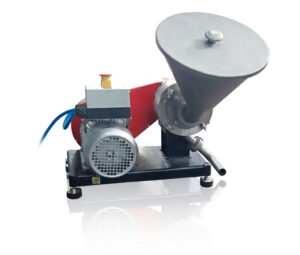
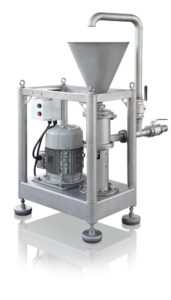
A mayonnaise production line consists of several essential components: a section for component resting, tanks for steam treatment, the main mixer tank, and a homogenizer or colloid mill.
To obtain a high-quality product, raw materials must meet certain requirements. Vegetable oil (sunflower, soya, olive, corn, peanut, and others), as one of the main components, must pass through a refining process including deodorization, and must be used within one month of refining. The following ingredients are used in dry form: egg powder, powdered cow’s milk (skimmed or whole), mustard powder, sugar, and salt. Vinegar is used as a 9-10% solution of acetic acid.
Preparing the Ingredients
The preparation stage of mayonnaise production consists of a series of steps. First, ingredients are prepared according to the recipe. Dry ingredients – egg and mustard powder, powdered milk, sugar, salt, and soda – are weighed and then sifted through a fine-meshed sieve. Sifting breaks large lumps and improves the moisture-retaining capacity of the powders. The required amounts of vegetable oil and water are poured into their respective storage tanks.
Preparing Egg Paste and Mustard-Milk Blend
Usually, egg paste is prepared first. Egg powder and water are delivered into a mixing tank and stirred with a paddle-type mixer for about 2-10 minutes. The mixture is then heated to 60-65°C, held for 15-20 minutes, and pumped through a homogenizer into the main mixing tank, where it cools to 20-30°C.
In a second tank, the mustard and milk blend is prepared. A homogenizer evenly distributes the dry ingredients (milk powder, mustard powder, salt, sugar and soda) in water, while a colloid mill provides additional grinding of solid fractions if necessary. The mixture sits for 20 minutes at 80-85°C to improve dissolution and achieve pasteurization, then cools to 20-30°C before being pumped into the main mixing tank.
Combining the Pastes and Adding Oil
In the main mixing tank, egg paste and mustard-milk paste are stirred for 5-10 minutes with a paddle-type agitator to obtain a homogeneous paste. The weight ratio of mustard-milk paste to egg paste ranges from 1.5-2.0:1 for high-calorie mayonnaise, and 2.2-2.8:1 for medium- and low-calorie versions.
Next, vegetable oil is delivered into the main mixing tank. For even distribution, the oil is introduced in a thin jet into the mixture of egg and mustard-milk pastes as it passes through a homogenizer. Simultaneously with the final portions of vegetable oil, a previously prepared cold (15-16°C) vinegar-salt solution is introduced.
The sequence and speed of adding vegetable oil and vinegar-salt solution are critical to successful mayonnaise production – simultaneous or accelerated introduction of these components can cause the emulsion to become lumpy.
Final Homogenization Stage
At the final stage, the coarse mayonnaise emulsion is pumped from the mixer tank through a homogenizer or colloid mill. Homogenization continues until a stable emulsion is obtained – in practice, this requires passing the mayonnaise emulsion through the homogenizer at least 2-3 times.
If the sample is entirely homogeneous, free of lumps, runs evenly, and has the viscosity, color, taste and smell typical of mayonnaise, the product is considered ready for packaging.
Storage Requirements
Mayonnaise is stored at 3-7°C. Freezing or excessive heat destroys its structure, and high temperatures dramatically reduce the shelf life of this remarkable product.