
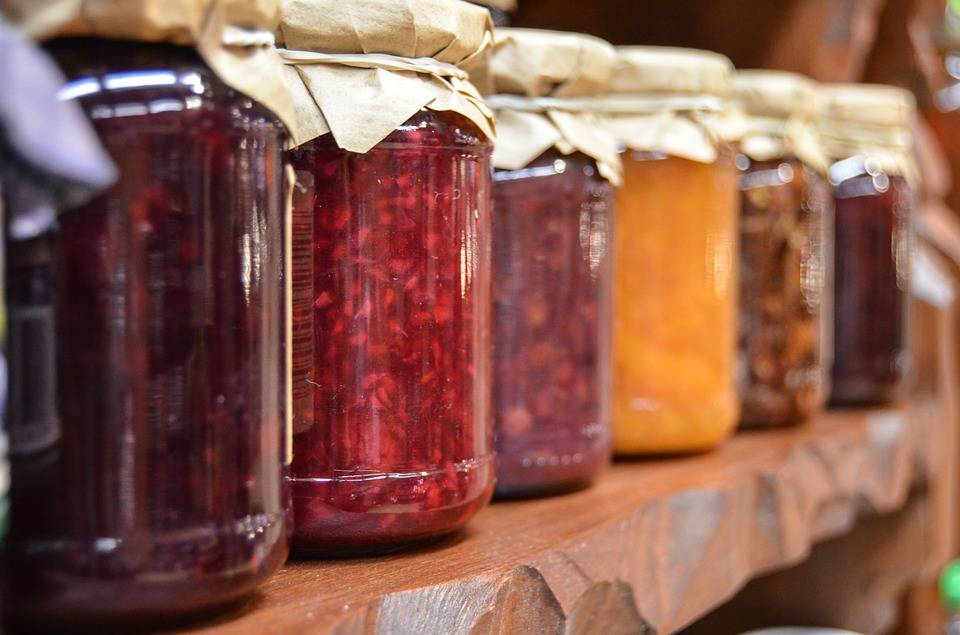
The modern food industry produces a wide range of products made from fruits and berries, such as preserves and jam, jelly and marmalade, and grated and crushed berries. At the heart of all this diversity are the preservative properties of high concentrations of sugar. When the amount of sugar is between 60 to 65%, sugar syrup creates high osmotic pressure, whereby microorganisms become dehydrated and perish. If the final product contains more than 65% solids, it can be stored for a long time without pasteurization. However, on an industrial scale, only fruit paste is produced without pasteurization, because during storage of preserve, jam, and other sugar-syrup products, moisture can accumulate in the upper layer, reducing sugar concentration and allowing fermentation.
Fruit Preserves: The Most Complex Stage of Jam Production
Fruit preserves have the most sophisticated production technology within jam production. This product consists of sugar syrup and fruit or berries that have retained their shape during boiling. To obtain high-quality preserves, fruits and berries must be heated repeatedly and continuously, preserving their marketable condition. The kind and maturity degree of the fruit is of great importance – underripe fruit can make preserves gelatinous due to high protopectin content, while overripe fruit will simply fall apart during cooking.
Briefly, the technological process is as follows: after preparation (sorting, removing stalks, seeds, and other debris), raw materials are blanched in hot water for a few minutes to soften the pulp and increase permeability. If fruits and berries have been conditioned with sulfur (sulfurizing) to improve storage capability, they must be pre-desulfurized by boiling.
Syrup is prepared from sugar (sometimes with 15% molasses added to reduce the risk of crystallization). If sulfurized raw material is used, sugar is added into the filtered solution remaining after desulfurization.
Cooking Equipment for Fruit Preserve and Jam Production
Traditionally, fruit preserves are prepared in special cooking boilers equipped with a steam jacket for heating the raw material and a paddle stirrer. Since fruits and berries are placed into syrup with high sugar concentration, diffusion of water from the fruit into the syrup happens faster than the reverse diffusion of syrup into the fruit. If cooking conditions are violated, this can cause berries to wrinkle, harden, and float. Preliminary blanching, pricking or rolling partially weakens the peel, allowing mutual diffusion of water and syrup to occur more evenly. Multiple boiling cycles with intermediate cooling (10 to 24 hours) improve soaking of the raw material with syrup, because during cooling, reduced internal pressure allows syrup to penetrate the peel more effectively. Each boiling cycle lasts 10 to 15 minutes, with total boiling time not exceeding 30 minutes.
It is much faster and more effective to cook fruit preserves in a vacuum apparatus – essentially the same cooking boiler with steam heating and a paddle stirrer, but additionally equipped with a seal cap and vacuum pump. Feedstock is cooked under reduced pressure for 10-15 minutes, then cooled under increased pressure for 10 minutes, before pressure is reduced again and boiling continues for a second cycle.
During cooking, solids content in the syrup is continuously monitored. The weight of solids in the finished product (after sugar has fully diffused into the fruit) should range between 68-70%, including fruit and berry content of 40-55%.
Jam Production: Requirements and Cooking Process
There is increased market demand for gelatinous products made from processed fruits and berries, such as jam and jelly. Raw material requirements for these products are higher than for preserves – ideally, fruits and berries should contain more than 1% pectin and at least 1% organic acids. If the raw material lacks sufficient pectin, it is supplemented with dry pectin powder or jellifying juices from gooseberry, quince, or apple.
Jam is prepared in a cooking boiler or vacuum unit equipped with a paddle stirrer. The jam production process involves a single cooking cycle, boiling until solids concentration reaches 69-73%. Prepared fruits or berries are loaded into the machine, filled with water or a mild (10%) sugar syrup, and blanched until the raw material softens. Concentrated sugar syrup or sugar is then added, and cooking continues until the product is ready. Jellifying juice is added 15-20 minutes before the end of boiling. To prevent crystallization during storage, citric acid is added, or 15% of the syrup’s sugar is substituted with molasses.
Jelly Production: A Denser Alternative
Jelly differs from jam in its denser consistency and the presence of small fruit pieces. Vessels with a capacity of no more than 150 liters are used for jelly preparation. During cooking, when solids concentration reaches about 55%, pectin is introduced, and the process continues until solids concentration in the syrup reaches about 60%. Boiling is done relatively quickly (up to half an hour), which helps the product better preserve vitamins, flavor and fruit aroma. Citric or tartaric acid is added a couple of minutes before the end of cooking, bringing the acid concentration to 0.8-1.3%.
Fruit Paste Production
Fruit paste is produced by boiling pre-prepared puree with sugar in a cooking boiler or vacuum unit equipped with a paddle stirrer. Fruit paste has a jelly-like consistency and a sour taste, due to added pectin and citric or tartaric acid. If fruit paste is prepared from sulfited feedstock, the puree must first be pre-boiled without sugar until solids concentration reaches 15%, after which sugar is added according to the recipe and boiling continues until the product is ready. If the initial puree has a thick consistency, it is boiled with half the sugar amount until solids reach 45%, then the remaining sugar is added and boiling continues to completion. If liquid puree is used, the puree and the full amount of sugar are added to the cooking vessel simultaneously. Cooking time for fruit paste should not exceed 50 minutes, as exceeding this limit impairs the quality of the final product.
If a vacuum apparatus is used, puree with sugar is warmed at atmospheric pressure for a few minutes, then cooked under reduced pressure until done. If the raw material requires desulfurization, it is first pre-conditioned in open apparatuses, then sugar is dissolved and the mixture is brought to a boil, after which boiling continues under reduced pressure until ready.
At the end of the jam cooking process, pressure in the vacuum unit is briefly raised to atmospheric level, and the temperature is brought to 100°C.
GlobeCore Equipment for Jam Production
The quality of the finished products depends equally on the quality of raw materials and the equipment used. GlobeCore food containers are made of high-quality stainless steel and equipped with reliable paddle mixers, ensuring consistent results across every stage of jam production. Small containers with a capacity of 100-300 kg per cycle are intended for small- or medium-scale production, or for testing recipes at large enterprises. For large-scale production, cooking vessels with a capacity of up to 5000 kg/cycle are available. GlobeCore equipment stands out for its high efficiency, minimal technological losses of raw materials, reduced cleaning time, and low energy consumption.