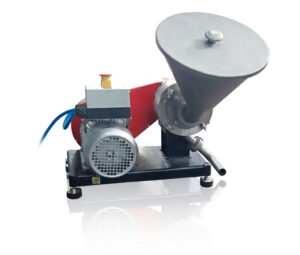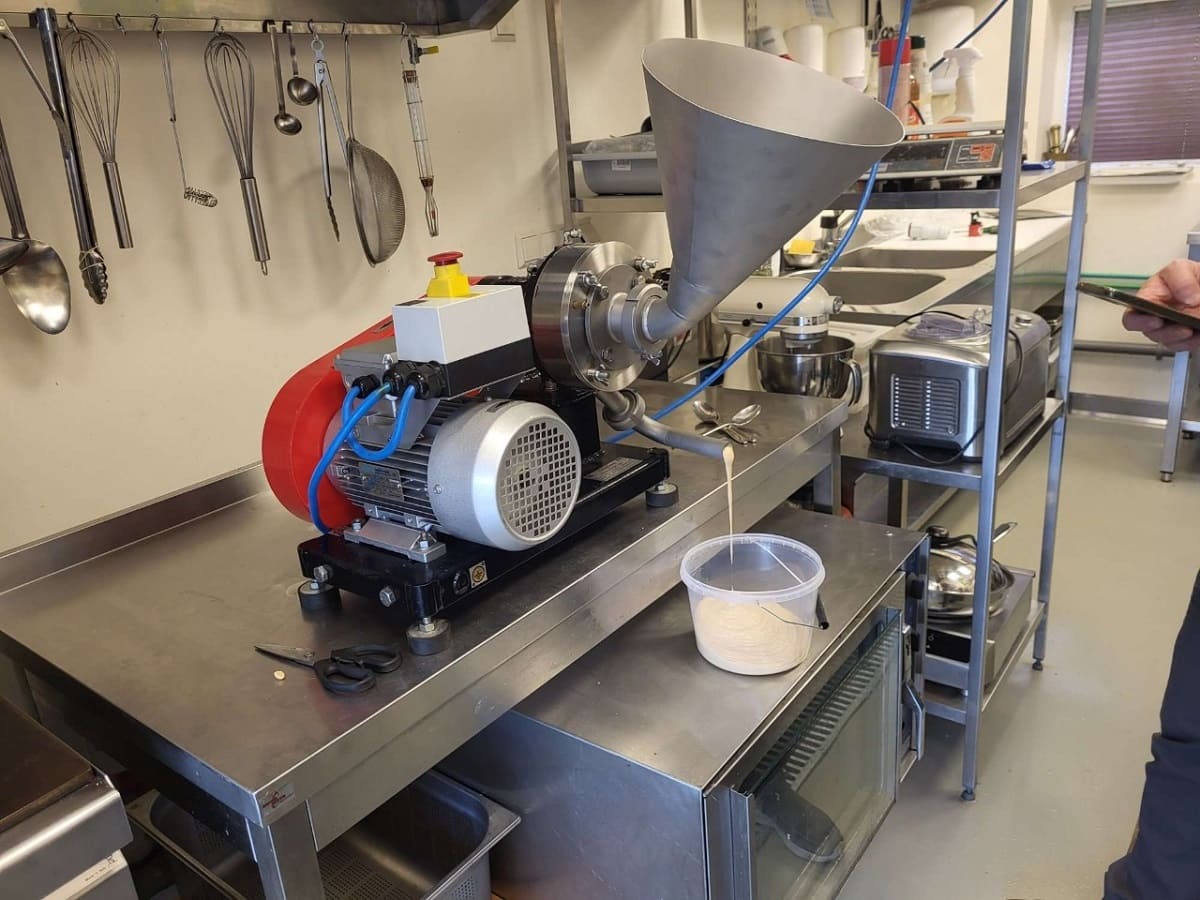
A coconut grinder can mean two fundamentally different machines. Dry coconut flour, desiccated coconut, or free-flowing particles require dry size-reduction equipment. A coconut paste, slurry, sauce base, or another pumpable formulation may require wet grinding, dispersion, emulsification, or homogenization. The GlobeCore CLM-100.3 is a food-industry colloid mill for the second type of duty: fine wet processing to a paste-like consistency under high-shear conditions. It is not a general-purpose machine for whole coconuts or dry flour.
Define the coconut process before selecting a grinder
The required operation should be defined by the feed condition and the desired product, not by the word “grinder.” A production team should first determine whether coconut is entering the process as a dry solid, prepared coconut meat, a coarse paste, or a flowable mixture containing a liquid phase.
| Process objective | Typical operation | Colloid mill role |
|---|---|---|
| Make dry coconut particles or flour | Dry cutting, crushing, or pulverizing | Not the intended duty |
| Prepare a coarse, flowable coconut feed | Pre-cutting, pre-grinding, and mixing | Separate upstream operations |
| Refine a coconut paste or thick slurry | Wet particle-size reduction and dispersion | Potentially relevant |
| Improve uniformity in a liquid-containing formulation | Dispersion, emulsification, or homogenization | Potentially relevant after formulation testing |
| Produce and pack a finished food | Thermal treatment, quality control, filling, and packaging | Separate downstream operations |
GlobeCore documentation lists coconut grinding among applications of CLM colloid mills. That establishes application relevance, but it does not show that every coconut recipe can be processed under the same conditions. Coconut variety, moisture, fat behavior, added liquid, solids content, and the condition of the prepared feed can materially change the result.
Dry grinding versus wet coconut processing
Dry coconut grinding
If the target is a dry powder, granule, or flake, the core requirement is dry comminution. A dry grinder, cutter, pulverizer, or another suitable size-reduction machine should be evaluated. A colloid mill should not be selected merely because it contains the word “mill.”
The CLM-100.3 is documented for fine grinding to a paste-like consistency and for producing a thick slurry under high shear. Those are wet or paste-processing duties, not evidence of dry-powder capability.
Wet coconut grinding
Wet processing begins with a formulation that can move continuously into and through the working chamber. The objective may be to reduce prepared coconut particles, distribute solids through a liquid phase, refine a paste, or improve formulation uniformity.
A colloid mill is one stage in that process. It does not wash coconuts, remove husks or shells, peel, perform the initial cutting of whole material, cook, sterilize, fill, or package the product. Each required operation must have its own equipment and control plan.
How the CLM-100.3 processes a coconut slurry
The CLM-100.3 colloid mill uses a rotor–stator working system. The rotor is the moving element and the stator is stationary. Prepared product enters the working chamber, passes through the rotor–stator system, and is discharged after exposure to high shear and changing flow conditions.
For coconut processing, this action can combine wet particle-size reduction with dispersion. If the recipe contains phases that must be distributed into one another, the same high-shear stage may also contribute to emulsification and homogenization. It should not, however, be treated as a substitute for every mixer or homogenizer in a line.
- Colloid mill: applies intensive rotor–stator shear to a flowable product for fine wet grinding and related dispersion duties.
- Agitated mixer: combines ingredients and maintains bulk uniformity in a vessel; it may not provide the same size-reduction action.
- Dry grinder: reduces dry solids without requiring a pumpable slurry.
- High-shear mixer or disperser: may be used for rapid incorporation and dispersion in a tank; selection depends on the recipe and process objective.
- Homogenizer: is selected when a defined homogenization mechanism and validated finished-product result are required.
- Ball mill: uses a different grinding mechanism and process arrangement; it is not interchangeable with an inline rotor–stator mill.
Feed preparation is the main process boundary
The colloid mill must receive prepared material rather than whole coconuts. The upstream line may therefore need washing, shell and peel removal, inspection, cutting, coarse grinding, liquid addition, and premixing. The exact sequence depends on the product and food-safety plan.
From an engineering standpoint, the feed must be sufficiently flowable for controlled delivery through the mill. Large, hard, or irregular pieces should be removed or reduced by suitable upstream equipment. A premix tank and controlled feed arrangement may also be required to keep the formulation uniform as it enters the processing stage.
Do not use a generic coconut-grinding trial to qualify a commercial recipe. Testing should use the actual coconut raw material, liquid phase, additives, and expected inlet temperature.
Practical factors for selecting a coconut grinder
Product objective
Define the required texture and, where applicable, the target particle-size distribution. “Smooth paste” is useful for product development, but equipment selection needs a measurable acceptance criterion and an agreed sampling method.
Flowability, solids content, and viscosity
A formulation that does not feed consistently cannot be evaluated on nominal mill capacity alone. Document viscosity or another suitable rheological description at the intended processing temperature. Also identify the solids concentration and whether the feed settles, separates, or changes consistency while waiting in the feed vessel.
Temperature control
Mechanical processing can affect product temperature. Establish the inlet condition, maximum acceptable outlet temperature, allowable residence time, and whether an external heating or cooling step is needed. No temperature limit should be assigned to the CLM-100.3 without confirmation for the proposed configuration.
Working gap and processing cycles
The rotor–stator clearances and processing conditions influence the mechanical action applied to the product. A more intensive setting is not automatically better: it may change temperature, flow, texture, and production rate. Determine the working-gap setting and the required number of passes by testing. A recirculation loop or staged arrangement, if needed, must be engineered as part of the line rather than assumed to be included with the mill.
Throughput
The documented capacity of the CLM-100.3 is 0.1 m³/h. This value should not be treated as guaranteed coconut-formulation throughput. Actual results depend on the material, recipe, initial particle size, solids content, viscosity, temperature, feed rate, working gap, and number of processing cycles.
Materials and food-contact requirements
GlobeCore states that the CLM-100.3 wetted components are made of stainless, chemically resistant steel. The buyer should still review the proposed machine configuration against the facility’s ingredient-compatibility rules, sanitation procedures, allergen controls, and applicable food-contact requirements.
Cleaning and line integration
Define how the mill, feed piping, valves, vessel, and downstream piping will be drained, opened, inspected, and cleaned. Coconut fats and retained solids make access and cleaning validation important considerations. Confirm the cleaning method with GlobeCore for the proposed configuration rather than assuming a specific clean-in-place capability.
The equipment review should also cover electrical supply, feed method, piping connections, discharge destination, available space, operator access, controls, instrumentation, and safeguards. The food-industry equipment section provides the appropriate context; bitumen-emulsion and bitumen-modification plants are different production systems and should not be used as the basis for a food-line selection.
A sensible coconut-processing line concept
- Receive and inspect the coconut raw material.
- Complete any required washing, shell removal, peeling, and cutting with separate equipment.
- Pre-grind the material to a feed condition acceptable for wet processing.
- Add the recipe’s liquid phase and other ingredients in a suitable mixing vessel.
- Feed the flowable premix to the colloid mill at a controlled rate.
- Evaluate the discharge for texture, particle size, uniformity, and temperature.
- Recirculate or make another pass only if testing shows that it is necessary and the line is designed for it.
- Send the product to separate downstream thermal treatment, holding, filling, or packaging stages as required.
Frequently asked questions
Can the CLM-100.3 grind a whole coconut?
No such capability is established by the retrieved documentation. Whole coconuts require upstream handling, shell removal, preparation, cutting, and coarse size reduction. The CLM-100.3 should be evaluated for a prepared, flowable feed.
Can it produce dry coconut flour?
The documented CLM-100.3 duty is fine grinding to a paste-like consistency and production of a thick slurry under high shear. Dry flour production calls for dry-grinding equipment and a different process design.
Is the CLM-100.3 only a grinder?
No. Its rotor–stator action is relevant to fine wet grinding and dispersion, and it may contribute to emulsification or homogenization in an appropriate liquid-containing recipe. It is not a substitute for bulk premixing, upstream preparation, thermal processing, or packaging equipment.
Will one pass produce the required texture?
That cannot be guaranteed from the keyword or nominal machine data. The result depends on the actual formulation and operating conditions. Testing should establish the working setting, feed rate, temperature behavior, and number of cycles.
Is 0.1 m³/h guaranteed for coconut paste?
No. It is the documented CLM-100.3 capacity, not a guaranteed production rate for every coconut formulation. Qualification with the customer’s actual material is necessary.
Discuss the application with process data
If your project requires a wet-processing coconut grinder, GlobeCore can review whether the CLM-100.3 fits the intended duty. Please provide the complete formulation, feed condition and initial particle size, required throughput, target texture or particle size, solids content, viscosity, operating and temperature limits, cleaning method, available utilities, and all inlet, outlet, recirculation, control, and production-line connection requirements. A trial with the actual formulation is recommended when the required result is not already confirmed by documented data.