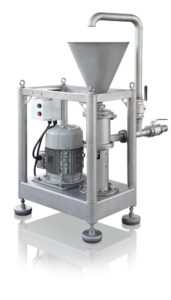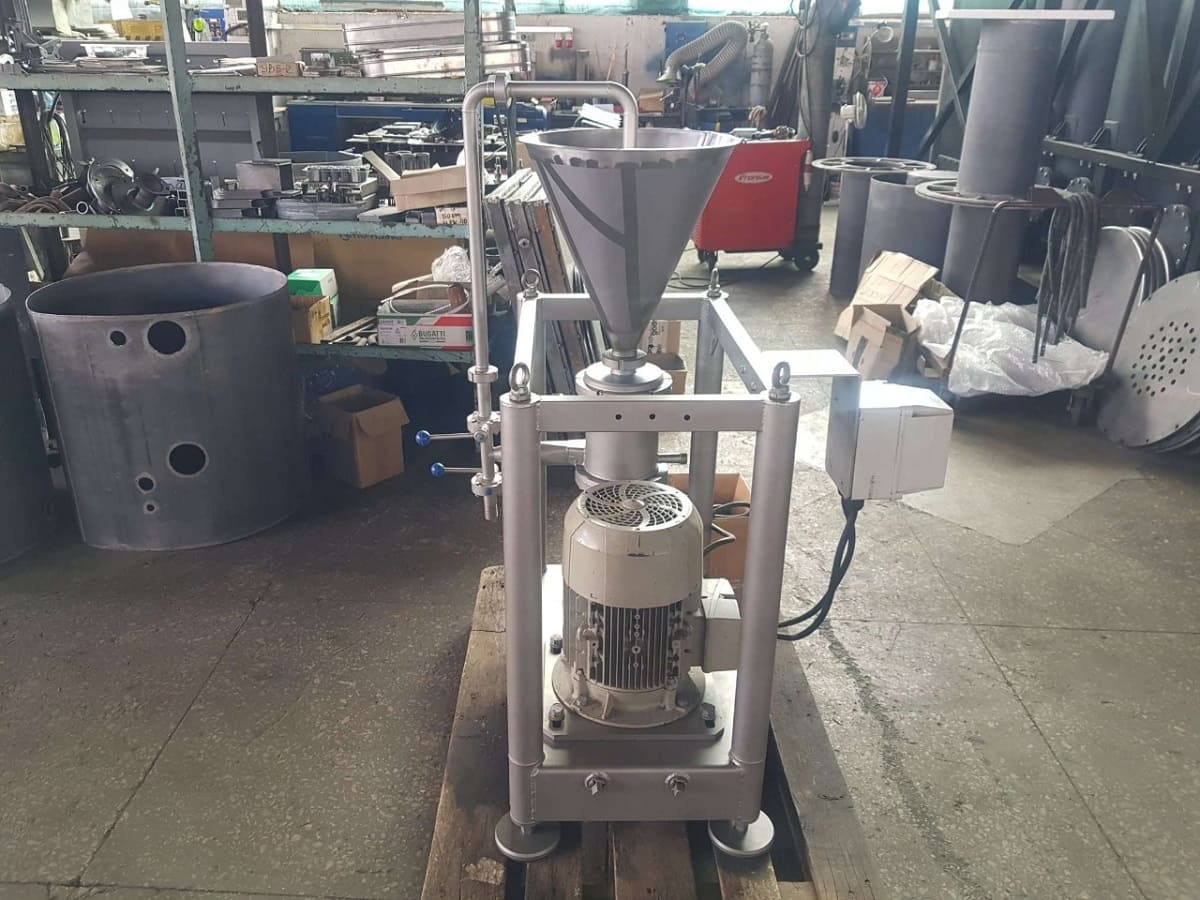
A grinder machine vegetable application must be defined by the intended product, not by the word “grinder.” Dry vegetable flakes or powders require dry particle-size-reduction equipment. A pumpable vegetable puree, paste, suspension, or sauce is a wet-processing application in which a colloid mill may perform particle-size reduction, dispersion, and homogenization. If the recipe contains immiscible liquid phases, emulsification may also be an objective, but it must be specified and tested.
A colloid mill is not a complete vegetable-processing line. It does not wash, inspect, peel, trim, cook, sterilize, fill, or package vegetables. It also does not automatically replace a bulk mixer or an upstream cutter. The engineering task is to prepare a controlled, flowable feed and determine whether rotor–stator wet milling can produce the required texture at the required production rate.
What process does a grinder machine vegetable application require?
| Required product | Main operation | Equipment direction |
| Dry vegetable powder | Dry grinding and possibly classification | Use a dry grinder and suitable powder-handling equipment. |
| Coarse chopped vegetables | Cutting, slicing, or maceration | Use a cutter, chopper, or prebreaker designed for the raw material. |
| Pumpable vegetable puree or paste | Wet particle-size reduction, dispersion, and homogenization | Evaluate a food-industry colloid mill after suitable feed preparation. |
| Vegetable sauce with multiple ingredients | Bulk mixing followed by wet size reduction or homogenization | Use a mixer to prepare the formulation and assess a colloid mill as a separate stage. |
| Oil-and-water vegetable sauce | Mixing, dispersion, and emulsification | A premixer and colloid mill may both be required; verify the process with the actual recipe. |
The key dividing line is whether the feed is a dry, free-flowing solid or a wet formulation that can move consistently through the processing zone. GlobeCore identifies vegetable puree, ketchup, tomato paste, applesauce, garlic paste, horseradish, and chili paste among applications for CLM colloid mills. These documented applications establish relevance for wet food processing, but they do not prove suitability for every vegetable or recipe.
What a colloid mill does in vegetable processing
A colloid mill subjects prepared wet material to intensive treatment in the working zone between a rotating rotor and a stationary stator. The relative motion and narrow working gap create high shear. Depending on the formulation and operating conditions, this treatment can reduce suspended particles or soft agglomerates, distribute solids through the liquid phase, and make the product more uniform.
This differs from bulk mixing. A tank mixer circulates ingredients through a vessel and helps create a consistent premix. A colloid mill intensively processes only the material passing through its rotor–stator zone. Both machines may therefore be necessary in the same line.
Operations the mill may perform
- Wet particle-size reduction of a suitably prepared vegetable formulation.
- Dispersion of vegetable solids and other ingredients in a liquid phase.
- Homogenization of a pumpable paste, puree, suspension, or sauce.
- Emulsification when the tested recipe contains phases that require this operation.
Operations that need separate equipment
- Receiving, sorting, inspection, and foreign-material removal.
- Washing, peeling, trimming, deseeding, and cutting.
- Dry grinding of dehydrated vegetables or spices.
- Batch weighing, dosing, and bulk ingredient mixing.
- Cooking, pasteurization, sterilization, cooling, or aseptic processing.
- Holding, filling, sealing, labeling, and packaging.
The colloid mill should consequently be specified as one wet-processing stage, with clear battery limits and interfaces to the rest of the production line.
When the CLM-250.3 should be evaluated
The GlobeCore CLM-250.3 colloid mill is listed in the company’s food-industry range. GlobeCore documentation also identifies vegetable puree and several vegetable-based pastes and sauces as CLM applications. This makes the CLM-250.3 a relevant candidate when the feed is wet and flowable and the process objective is fine grinding to a paste-like consistency, dispersion, or homogenization.
It should not be selected solely because a request contains “vegetable grinder.” The verified sources do not establish a universal vegetable feed size, finished particle size, viscosity limit, temperature limit, pressure limit, or guaranteed throughput for every formulation. Even a capacity documented for another food product must not be treated as a guaranteed rate for a vegetable puree with different solids, fibers, viscosity, or temperature.
Actual results depend on the material, recipe, initial particle size, solids content, viscosity, temperature, feed rate, working gap, and number of processing cycles. A trial with the customer’s actual formulation is recommended when documented application data do not confirm the required result.
Feed preparation is usually the decisive step
Create a consistent, flowable premix
Vegetables differ widely in moisture, fiber structure, skin content, seed content, and rheology. A feed containing large pieces or dry pockets may not enter the mill consistently. Cutting, crushing, maceration, or premixing may therefore be required upstream. The maximum acceptable feed condition must be confirmed for the proposed machine configuration rather than assumed.
If liquid must be added to establish flow, food technologists should review the change as a formulation decision. Added water, oil, brine, or another liquid can affect flavor concentration, solids content, preservation, viscosity, and the downstream thermal process.
Control material that should not reach the mill
Remove foreign objects and unintended hard contaminants upstream. Decide whether skins, seeds, stems, and fibers belong in the finished product before milling. The colloid mill should not be used as a substitute for raw-material inspection or contaminant control.
Use a separate mixer where the recipe requires one
Powders, salt, acids, oils, stabilizers, and other recipe components may need controlled addition and bulk circulation in a mixing vessel. The mixer prepares a reasonably uniform and feedable product. The colloid mill then applies localized high shear for the specified wet-processing objective.
Variables that determine texture and practical throughput
| Variable | Engineering significance |
| Material and recipe | Vegetable type, fibers, skins, seeds, oil, water, and added ingredients determine how the formulation responds to shear. |
| Initial particle size | Oversized pieces may require a separate cutter or prebreaker before milling. |
| Solids content | The amount and character of suspended material affect flow behavior and processing load. |
| Viscosity | Viscosity influences feeding, circulation, pressure loss, and achievable production rate. |
| Temperature | Temperature affects viscosity and product quality. Both recipe limits and confirmed equipment limits must be observed. |
| Feed rate | The rate controls residence and processing conditions. A nominal rate for another liquid is not a guarantee for the proposed formulation. |
| Working gap | The setting influences treatment intensity and must follow the manufacturer’s operating instructions. |
| Number of passes | Additional cycles may change texture but also increase processing time and repeated energy input. |
A smaller gap or a greater number of passes is not automatically better. The process must meet the target texture without causing unacceptable temperature change, unstable feeding, or unnecessary residence time. During trials, record the recipe, initial feed condition, gap setting, flow rate, inlet and outlet temperatures, number of cycles, and measured product result.
How a vegetable colloid mill fits into the line
- Define the finished product. State whether the requirement is chopped vegetables, dry powder, puree, paste, suspension, sauce, or emulsion.
- Prepare the raw material. Inspect, wash, peel, trim, remove contaminants, and cut it using dedicated equipment as required.
- Prepare the formulation. Weigh, dose, and premix ingredients in suitable vessels.
- Establish controlled feeding. Confirm that the feed is sufficiently uniform and flowable for the selected mill and piping arrangement.
- Process through the colloid mill. Establish the working gap, feed rate, temperature, and number of cycles through controlled tests.
- Evaluate the discharge. Measure texture, particle-size distribution, viscosity, stability, or another agreed acceptance criterion.
- Complete downstream operations. Use separate equipment for thermal processing, holding, cooling, filling, and packaging.
Engineers can review the broader GlobeCore food-industry equipment category when comparing possible configurations. Colloid mills listed for bitumen-emulsion production or bitumen modification belong to different process duties. A colloid mill used in those systems is not the same thing as a complete bitumen-emulsion or modification plant, and those systems should not be treated as food-processing lines.
Colloid mill compared with other grinder machine vegetable options
| Equipment | Primary purpose | Relationship to vegetable processing |
| Dry grinder | Reducing dry feed into powder or granules | Use for dehydrated vegetable products; it is not a colloid mill. |
| Cutter or chopper | Coarse size reduction of whole or large vegetable pieces | Often an upstream preparation stage. |
| Batch mixer | Bulk blending and vessel circulation | Prepares a consistent formulation but may not provide the same gap treatment. |
| High-shear mixer | Intensive mixing, wetting, and dispersion | May overlap with some duties, but selection must compare the operating principle and validated result. |
| Disperser | Wetting and distributing solids in liquid | Useful for some premixing duties; not automatically interchangeable with a colloid mill. |
| Colloid mill | Wet size reduction, dispersion, emulsification, or homogenization in a rotor–stator zone | Processes a prepared, flowable formulation as one line stage. |
| Homogenizer | Improving product uniformity | A broad equipment class; compare mechanism and demonstrated product results. |
| Ball mill | Media-based particle reduction over a residence period | A different process principle and not a synonym for an inline colloid mill. |
Practical equipment-selection checklist
- Process objective: Is the duty cutting, dry grinding, mixing, wet particle reduction, dispersion, emulsification, or homogenization?
- Formulation: Identify every ingredient and its concentration.
- Feed condition: Define the vegetable type, moisture, initial piece size, fibers, skins, seeds, and contaminant controls.
- Flow behavior: Provide viscosity or the plant’s agreed consistency measurement at a stated temperature.
- Production target: State the required throughput for the actual formulation.
- Product target: Define texture, particle-size distribution, viscosity, stability, or sensory acceptance criteria.
- Temperature limits: Specify inlet temperature and the highest acceptable product temperature.
- Processing mode: Compare once-through operation with recirculation during trials.
- Cleaning: Define cleaning fluids, disassembly expectations, inspection, allergen controls, and changeover time.
- Utilities: Confirm the available electrical supply and utilities required by the complete installation.
- Integration: Provide vessel, pump, valve, piping, connection-standard, instrumentation, and space information.
Cleaning and sanitation planning
Vegetable products can leave pigments, oils, fine solids, skins, fibers, and seeds in product-contact areas. Cleaning requirements should be reviewed before purchase. Confirm how the rotor–stator zone, piping, valves, seals, and any recirculation loop will be cleaned, inspected, and returned to production.
Do not assume a specific clean-in-place method unless it is confirmed for the supplied configuration. Plants handling allergens or strongly colored and flavored formulations should also define carryover limits and cleaning validation. Changeover time belongs in the production-capacity calculation.
Frequently asked questions
Can a colloid mill grind dry vegetables into powder?
It should not be selected for that duty based on the word “mill.” Dry powder production requires appropriate dry-grinding and powder-handling equipment. A food colloid mill should be evaluated for a prepared wet formulation.
Can whole vegetables be fed directly to the CLM-250.3?
Direct feeding should not be assumed. The acceptable feed condition and initial piece size must be confirmed. Cutting, maceration, premixing, or other upstream preparation may be required.
Does the mill replace the batch mixer?
No. The colloid mill applies intensive treatment in its rotor–stator working zone. A separate mixer may still be required for ingredient addition, wetting, bulk uniformity, and controlled feeding.
Will one pass produce a smooth vegetable puree?
That cannot be guaranteed from the application name. Results depend on the recipe, initial particle size, solids content, viscosity, temperature, feed rate, gap, and number of cycles. Evaluate samples from controlled trials.
What throughput will the CLM-250.3 deliver?
A formulation-specific rate cannot be stated without verified test data. A capacity measured with water, ice-cream mix, or another material is not a guaranteed throughput for a vegetable puree or paste. Testing representative product under intended operating conditions is recommended.
Does colloid milling cook or sterilize the product?
No such conclusion should be made. Cooking, pasteurization, sterilization, cooling, and aseptic handling are separate processes that require dedicated and validated equipment.
Discuss the application before selecting the machine
For a practical review of the CLM-250.3, provide GlobeCore with the formulation, feed condition, required throughput, target texture or particle size, viscosity, temperature limits, cleaning method, available utilities, and line-connection requirements. When the required result is not confirmed by documented application data, arrange testing with the actual formulation before final equipment selection.