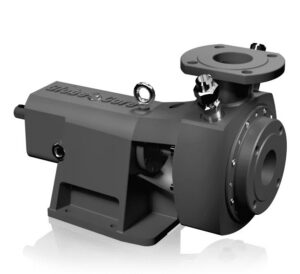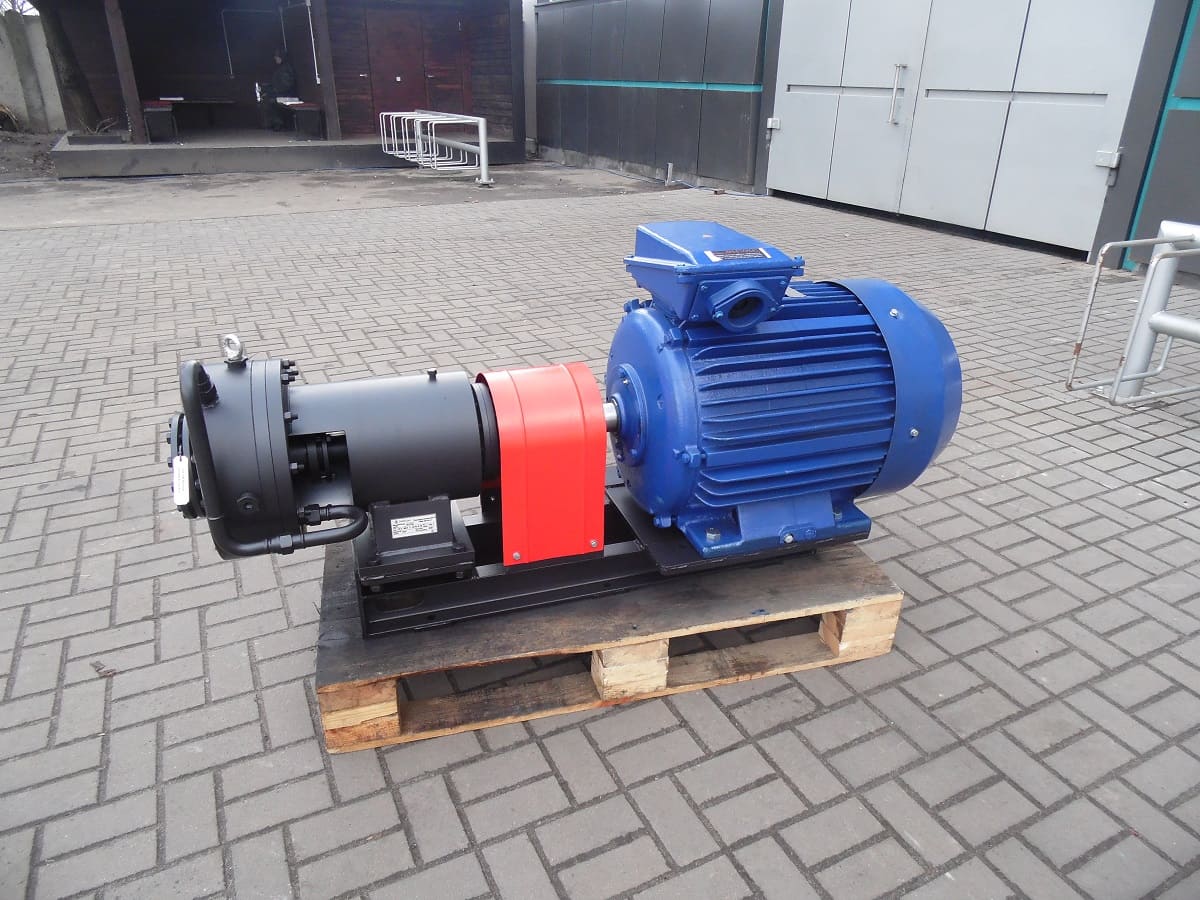
An asphalt emulsion mill is a wet-processing machine used to emulsify and homogenize prepared bitumen and aqueous phases. In the mill, mechanical shear disperses the bitumen phase into the water phase. This is not dry grinding, and the mill is not a complete emulsion plant: phase preparation, ingredient dosing, heating, pumping, finished-emulsion handling, and storage require separate equipment.
For a continuous road-material production line, the practical question is not simply whether a mill can process bitumen. The equipment must also match the formulation, feed condition, required flow rate, and surrounding process. The GlobeCore CLM-16/25 is documented for inline homogenization and emulsification of liquid products, particularly bitumen emulsions, with a stated capacity range of 16–25 m³/h. That nominal range should be evaluated against the actual recipe and operating conditions rather than treated as a guaranteed result for every emulsion.
What Process Does an Asphalt Emulsion Mill Perform?
Asphalt emulsion production is a wet emulsification and dispersion process. The feed streams are not dry solids. A prepared bitumen phase and a prepared water-based phase are brought together and processed under shear to form an emulsion.
| Operation | Role in asphalt emulsion production | Performed by the colloid mill? |
|---|---|---|
| Dry grinding | Reducing dry bulk solids before liquid processing | No |
| Phase preparation | Preparing bitumen and the aqueous formulation before emulsification | No |
| Bulk mixing | Blending ingredients in preparation vessels | Not a substitute for dedicated preparation mixers |
| Emulsification | Dispersing the bitumen phase into the water phase | Yes |
| Homogenization | Applying inline shear to improve distribution through the processed stream | Yes |
| Finished-product storage | Receiving and holding the produced emulsion | No |
GlobeCore documentation describes the production scheme as three functional sections: preparation of bitumen and water phases, processing in the colloid mill, and storage of the finished emulsion. This distinction is important when comparing a standalone mill with a complete bitumen-emulsion production system.
How the Rotor-Stator Stage Works
The CLM-16/25 uses a rotor–stator operating arrangement. The moving rotor and stationary stator contain concentric working rings. In operating position, these elements engage coaxially without contact, with axial and radial clearances between them.
Product enters the working chamber through the stator’s axial inlet, passes through the rotor-stator system, and leaves in the radial direction. Changes in flow velocity and shear conditions subject the combined phases to intensive mechanical processing. In asphalt emulsion service, the relevant results are dispersion, emulsification, and homogenization.
The rotor–stator stage should not be confused with a dry grinder, ball mill, or ordinary tank agitator. A tank mixer provides bulk circulation and ingredient blending. A colloid mill applies concentrated inline shear to a flowable liquid feed. A ball mill uses a different, media-based size-reduction mechanism. Likewise, a standalone colloid mill does not include every dosing, thermal, pumping, and storage function found in a complete production line.
Where the CLM-16/25 Fits in the Line
The CLM-16/25 colloid mill is designed for inline homogenization and emulsification, including the processing of thick liquid slurries under high shear stress. Its documented capacity is 16–25 m³/h. This rating is a selection reference, not a universal production guarantee.
Upstream equipment and controls
- Equipment for preparing and conditioning the bitumen phase
- A separate system for preparing the aqueous phase
- Ingredient measurement and controlled dosing
- Feed pumps and piping selected for the actual flow and viscosity
- Temperature monitoring and process controls appropriate to the formulation
The mill stage
- Receives flowable, prepared feed streams
- Combines and disperses bitumen in the water-based phase
- Provides inline emulsification and homogenization
- Connects to a continuous production line or suitable standalone process arrangement
Downstream equipment
- Transfer piping and pumping where required by the installation
- Finished-emulsion receiving and storage equipment
- Sampling and quality-control provisions
- A cleaning or flushing arrangement selected for the product and plant procedure
For a broader view of integrated systems, see GlobeCore’s bitumen-emulsion production equipment. Do not confuse this application with bitumen-modification equipment: polymer modification and water-based bitumen emulsification have different process objectives and line configurations.
Feed Preparation Is Part of Equipment Performance
The mill needs a consistent, pumpable feed. Preparation vessels must bring each phase to the required composition and feed condition before the streams reach the rotor–stator zone. Large foreign material, uncontrolled solids, or a feed that cannot flow reliably through the line should be addressed upstream rather than expected to be corrected by the mill.
Temperature and viscosity affect pumping, metering, shear conditions, and throughput. The relevant limits must therefore be established for the customer’s formulation and installation. No undocumented temperature, viscosity, pressure, or particle-size limit should be inferred from the model name or nominal capacity.
Actual results depend on the material, recipe, initial particle size, solids content, viscosity, temperature, feed rate, working gap, and number of processing cycles. If the required emulsion characteristics have not been demonstrated with the proposed recipe, testing with the customer’s actual formulation is the sound basis for confirming settings and performance.
Practical Asphalt Emulsion Mill Selection Factors
1. Define the product before selecting the machine
Provide the complete formulation and identify the bitumen phase, aqueous phase, additives, solids, and expected variability. The same nominal production rate can impose very different demands when viscosity or composition changes.
2. Match capacity to real process conditions
The CLM-16/25 has a documented nominal capacity of 16–25 m³/h. Confirm whether the required rate refers to instantaneous mill flow, sustained line output, or daily production. Allow for startup, changeover, cleaning, and any recirculation or additional processing cycles established during testing.
3. Evaluate the working gap and processing cycles
The working gap influences the mechanical conditions in the rotor–stator zone. It should be selected with the formulation, feed rate, temperature, viscosity, and target result in mind. More processing cycles are not automatically better; the necessary number should be determined experimentally when documented results are unavailable.
4. Review line hydraulics
Check the available feed pressure, pump selection, pipe sizes, valve arrangement, and downstream resistance as one system. A mill cannot compensate for unstable metering or a feed system that delivers the two phases inconsistently.
5. Plan cleaning and changeovers
Define the cleaning medium, flushing sequence, disposal or recovery method, access requirements, and acceptable downtime. Cleaning compatibility must be reviewed for the actual product and equipment configuration. Do not assume that a method used for one emulsion recipe is suitable for another.
6. Confirm utilities and integration
Before purchase, document the available electrical supply, process connections, controls interface, installation space, access for service, and any required thermal utilities. Connection details should be agreed from the final equipment configuration and plant layout.
Colloid Mill or Complete Production Plant?
| Selection | Appropriate when | What still must be addressed |
|---|---|---|
| Standalone colloid mill | The site already has suitable phase preparation, dosing, pumping, controls, and storage infrastructure | Mechanical, electrical, hydraulic, thermal, control, and cleaning integration |
| Complete bitumen-emulsion plant | A coordinated system is required for preparation, processing, and associated line functions | Site utilities, raw-material supply, finished-product handling, and project-specific connections |
| Laboratory system | The formulation and processing conditions must be developed or verified before production-scale selection | A scale-up plan based on actual test results |
A colloid mill can be the central emulsification device, but it remains one stage of the process. Buyers should compare the mill’s scope of supply with the functions required from the overall plant.
Frequently Asked Questions
Is an asphalt emulsion mill a dry grinder?
No. Asphalt emulsion production is wet processing. The colloid mill receives prepared liquid phases and applies inline shear for dispersion, emulsification, and homogenization.
Can the CLM-16/25 replace preparation tanks and mixers?
No. Separate equipment is required to prepare the bitumen and aqueous phases. The mill does not replace bulk ingredient mixing, dosing, or feed-conditioning systems.
Is 16–25 m³/h guaranteed for every formulation?
No. This is the documented capacity range for the CLM-16/25, but actual performance depends on the recipe, feed condition, solids, viscosity, temperature, feed rate, working gap, and processing cycles. Testing is recommended when performance with the actual formulation has not been confirmed.
Does the mill produce modified bitumen as well as asphalt emulsion?
Bitumen emulsification and bitumen modification are distinct applications. The machine and line configuration must be selected for the defined process; suitability should not be assumed from the word “mill.” Review the relevant bitumen-modification systems separately.
How should the final machine configuration be selected?
Base the decision on process data and, where needed, trials using the real formulation. The mill, pumps, preparation equipment, controls, piping, utilities, and finished-product system must work as one line.
Discuss the Application
To evaluate an asphalt emulsion mill for a new line or retrofit, provide the formulation, feed condition, required throughput, target texture or particle size, viscosity, temperature limits, cleaning method, available utilities, and line-connection requirements. GlobeCore can then review whether the CLM-16/25 and the proposed production arrangement match the actual process rather than relying on the keyphrase alone.