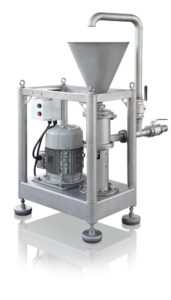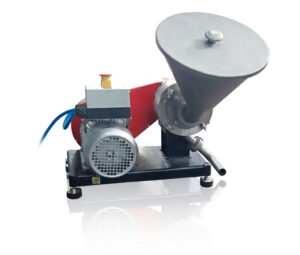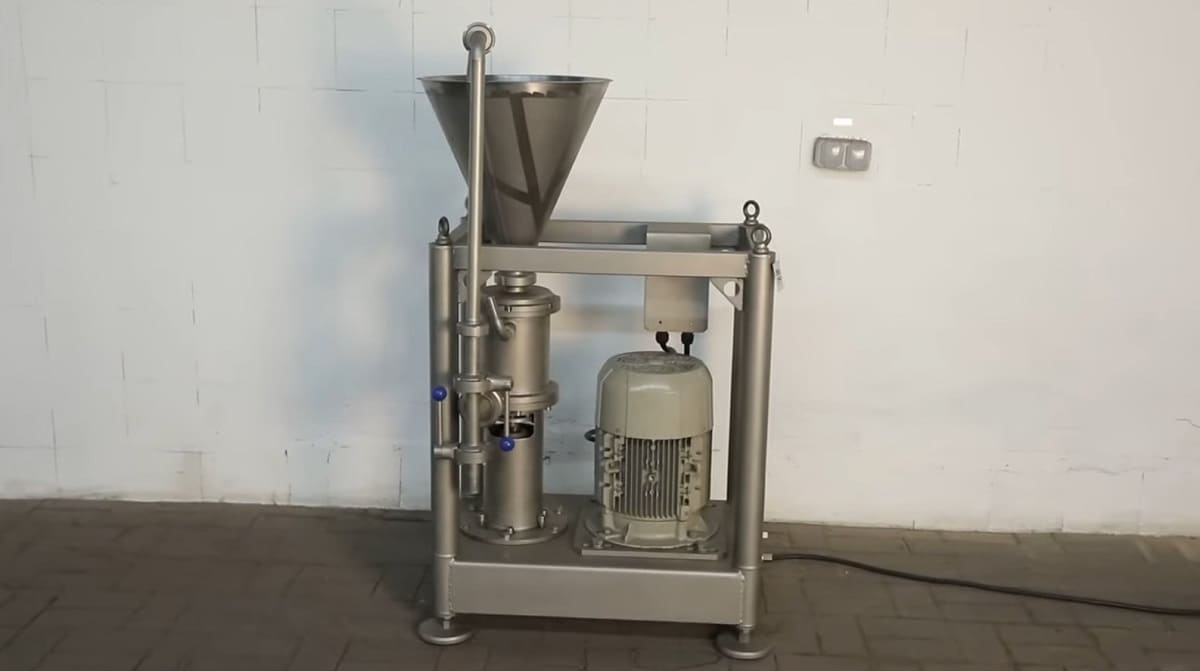
In industrial ketchup production, a colloid mill is a wet-processing stage used after the ingredients have been prepared and combined into a pumpable product. Its role is to reduce suspended particles, disperse solids, and homogenize the sauce. It is not a dry grinder, cooker, sterilizer, general-purpose batch mixer, filler, or complete ketchup line.
GlobeCore identifies ketchup as a food-industry application for CLM colloid mills. The CLM-250.3 colloid mill is therefore relevant for technical evaluation, but model selection must be based on trials and process data rather than the product name alone.
What process does ketchup production require?
Ketchup is processed as a liquid–solid food formulation. The relevant colloid-mill operation is wet processing, not dry grinding. Depending on the recipe and feed condition, the mill can contribute to particle-size reduction, dispersion, and homogenization.
| Operation | Role in ketchup processing | Colloid mill role |
|---|---|---|
| Ingredient handling | Receiving, weighing, and dosing tomato material, liquids, sweeteners, salt, spices, and other recipe components | Not performed by the mill |
| Mixing | Combining ingredients and preparing a reasonably uniform, flowable feed | A separate mixer is normally required |
| Particle-size reduction | Reducing suspended soft solids or agglomerates in a liquid phase | A principal colloid-mill function |
| Dispersion | Distributing fine solids throughout the continuous liquid phase | A principal colloid-mill function |
| Homogenization | Making texture and composition more uniform at the processed scale | A principal colloid-mill function |
| Cooking and thermal treatment | Developing the formulation and meeting the validated thermal process | Requires separate equipment |
| Filling and packaging | Transferring the finished product into saleable containers | Requires separate equipment |
Whether emulsification is a major objective depends on the formulation. It should not be assumed merely because a colloid mill can produce emulsions in other applications.
How a rotor-stator colloid mill works
A GlobeCore colloid mill uses wet milling in an adjustable gap between a rotating rotor and a stationary stator. Product passing through this working zone is subjected to turbulence, centrifugal action, and high relative motion between the rotor and stator. These effects reduce particles or agglomerates and improve dispersion and uniformity.
The mill is not equivalent to a tank agitator. An agitator circulates and blends the vessel contents, while the colloid mill applies intensive treatment in a narrow processing zone as product flows through it. The mill is also not a dry grinder: ketchup feed must arrive as a flowable wet formulation.
What the colloid mill can do
- Wet-process a prepared ketchup formulation.
- Reduce suspended particles and soft agglomerates that can enter the working zone.
- Disperse solids in the liquid phase.
- Improve product uniformity through homogenization.
- Operate as one stage within a larger production line.
What the colloid mill does not do
- Wash, sort, peel, or prepare tomatoes.
- Replace a dry spice grinder.
- Perform all bulk ingredient addition and tank mixing.
- Cook, sterilize, or validate the thermal process.
- Remove unsuitable foreign material.
- Fill, cap, label, or package the finished ketchup.
A practical ketchup production line arrangement
The exact sequence depends on the recipe and plant design, but the colloid mill should be treated as one processing stage rather than a complete line.
- Prepare the raw materials. Complete washing, sorting, peeling, dry grinding, or other ingredient preparation with dedicated equipment where the recipe requires it.
- Meter and combine the ingredients. Use suitable weighing, dosing, and mixing systems to create a consistent formulation.
- Establish a flowable feed. The product must reach the mill without pieces or contaminants that the selected machine and working gap cannot accept.
- Wet-process through the colloid mill. Select the working gap, feed rate, temperature, and number of cycles from trial results.
- Complete downstream treatment. Use separate equipment for holding, validated thermal processing, transfer, filling, and packaging.
A recirculation arrangement may be evaluated when more than one processing cycle is needed. A once-through arrangement may be considered when one pass meets the specified texture and uniformity. The correct choice must be demonstrated with the actual product.
Evaluating the CLM-250.3 for ketchup production
The GlobeCore CLM-250.3 is the key machine to assess for this application because GlobeCore documents CLM colloid mills for ketchup production and provides a dedicated food-industry product page for this model. That evidence establishes relevance for evaluation; it does not establish guaranteed capacity or finished texture for every ketchup recipe.
No throughput, particle-size result, pressure, temperature, or viscosity limit should be transferred from water or another product to ketchup without confirmation. Actual results depend on the material, recipe, initial particle size, solids content, viscosity, temperature, feed rate, working gap, and number of processing cycles. Testing with the customer’s actual formulation is recommended.
Feed preparation and flowability
The upstream mixer must prepare a feed that can move consistently to the mill. Large pieces, poorly wetted powders, and concentrated pockets of solids can make feeding irregular and prevent repeatable processing. Screens, prebreakers, pumps, or other preparation equipment may be required, but their selection must be based on the real formulation and the confirmed inlet conditions of the proposed mill.
Working gap and number of passes
A smaller working gap is not automatically the correct setting. The setting must account for the initial particle size, product flow, required texture, and acceptable temperature rise. Begin trials from a safe configuration confirmed for the equipment, inspect the product after each cycle, and tighten the setting only when justified by the result and operating condition.
Multiple cycles can provide additional treatment, but they also increase processing time and repeated energy input. The required number of passes should be established by sample evaluation rather than assumed in advance.
Viscosity, temperature, and throughput
Ketchup behavior varies with formulation and temperature. A throughput quoted for another liquid is not a guaranteed ketchup rate. During testing, record feed temperature, apparent viscosity or the plant’s agreed consistency measurement, solids content, flow rate, mill setting, motor load where available, number of cycles, and outlet temperature. These records provide a sound basis for scale-up and acceptance criteria.
Colloid mill compared with other equipment
| Equipment | Primary purpose | Relationship to ketchup processing |
|---|---|---|
| Batch mixer | Bulk blending and vessel circulation | Usually prepares the colloid-mill feed |
| Dry grinder | Reduces dry ingredients before liquid addition | Separate upstream operation when required |
| High-shear mixer | Intensive mixing and dispersion in a vessel or inline zone | May overlap with some duties, but it is not automatically interchangeable with a colloid mill |
| Colloid mill | Wet particle-size reduction, dispersion, and homogenization in a rotor–stator gap | Processes a prepared, flowable ketchup formulation |
| Homogenizer | A broad equipment class used to improve uniformity | The operating principle and validated result must be compared, not only the equipment label |
| Disperser | Wets and distributes solids in a liquid | May be useful during premixing; does not necessarily provide the same gap treatment |
| Ball mill | Media-based size reduction over a residence period | A different operating principle and not a direct synonym for an inline colloid mill |
For a wider view of available wet-processing equipment, see the food-industry colloid mill category and the GlobeCore colloid mill equipment overview.
Equipment-selection checklist
- Recipe: Identify every ingredient, concentration, and addition sequence.
- Feed condition: Define initial particle size, agglomerates, foreign-material controls, and whether powders are already wetted.
- Rheology: Provide viscosity or the agreed consistency test at a stated temperature.
- Process objective: State whether the priority is smoother texture, particle reduction, dispersion, or general uniformity.
- Required production rate: Specify the target throughput for the actual ketchup, not for water.
- Temperature limits: Define inlet temperature and the highest acceptable product temperature.
- Operating mode: Decide whether trials should examine once-through or recirculating processing.
- Cleaning: Define the cleaning method, cleaning fluids, disassembly expectations, and changeover requirements.
- Utilities: Confirm the available electrical supply and any utilities required by the complete installation.
- Integration: Provide pipe sizes, connection standards, pump arrangement, available space, and upstream and downstream equipment details.
Cleaning and production-line integration
Food equipment selection must include a cleaning review. Product-contact areas, the rotor–stator zone, piping, valves, seals, and any recirculation loop must be included in the plant’s documented cleaning procedure. Do not assume a specific clean-in-place capability unless it is confirmed for the supplied configuration.
The line must deliver a stable feed to the mill and carry the processed ketchup away without uncontrolled restriction. Pump selection, vessel level, piping geometry, valves, instrumentation, and line connections should be reviewed as one system. The colloid mill should not be expected to correct an unstable feed or replace the necessary upstream and downstream controls.
Frequently asked questions
Is ketchup production a dry-grinding application?
No. Processing the combined ketchup formulation in a colloid mill is a wet operation. Dry spices or other dry solids may need separate preparation before they are added to the liquid formulation.
Can the CLM-250.3 replace the main mixing tank?
No. The mill applies wet rotor–stator treatment to material passing through its working zone. Bulk ingredient incorporation, recipe control, and tank circulation require appropriately selected mixing and handling equipment.
Will one pass produce the required texture?
That cannot be confirmed from the application name alone. The result depends on the formulation and operating conditions. Compare samples after controlled trials at documented settings and numbers of cycles.
What capacity will the CLM-250.3 deliver on ketchup?
A ketchup throughput should not be inferred from a nominal rating for water or another formulation. Confirm the production rate by testing representative product under the intended temperature, viscosity, solids content, feed, and working-gap conditions.
Does a colloid mill sterilize ketchup?
No sterilization claim should be made for the colloid-milling stage. Any required cooking, pasteurization, sterilization, holding, or aseptic operation must be designed and validated separately.
How should a mill be selected for a new recipe?
Run tests with the actual formulation and document the feed condition, settings, flow rate, number of cycles, temperature response, and resulting texture or particle-size measurement. This is more reliable than selecting a machine from the word “ketchup” alone.
Discuss the application with GlobeCore
For a practical evaluation of the CLM-250.3 in a ketchup line, provide the formulation, feed condition, required throughput, target texture or particle size, viscosity, temperature limits, cleaning method, available utilities, and line-connection requirements. GlobeCore can then review whether the proposed colloid-mill stage should be tested with your actual product and how it may connect to the rest of the process.