
Colloid mill CLM-200.2
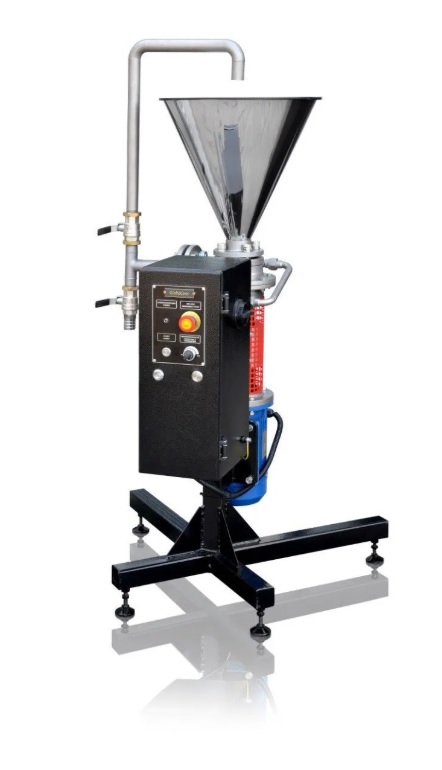
The CLM-200.2 colloid mill is built for laboratory-scale homogenization and emulsification of liquid products, capable of producing thick, high-shear-stress slurries when formulations call for it. It’s a flexible tool for preparing, dissolving, and processing a wide range of products across different industries – right at the bench.
What It’s Used For
The CLM-200.2 gives laboratories a reliable way to handle:
- Preparation and dissolution of liquid products across a range of industrial application
- Formulation of dense, high-shear slurries for testing and quality evaluation before scaling up
Its laboratory footprint makes it well suited for R&D departments, formulation labs, and quality control settings where flexibility matters as much as precision.
Principle of Operation
The mill runs on a rotor/stator system: a rotor and stator, each made up of concentric tool rings – cutters and knives – machined with grooves and holes to deliver a controlled, optimal level of mechanical force to the product.
In operation, the rotor and stator tool rings sit coaxially and rotate relative to one another without direct contact, at speeds ranging from 15 to 30 m/s. This adjustable speed range gives operators finer control over shear intensity than the higher-speed models in the CLM lineup – useful for formulations that require a gentler touch. Contact-free rotation is maintained through carefully engineered axial and radial gaps between the components.
How the product moves through the mill:
- Product enters the operating chamber through the stator’s axial bore (inlet)
- It travels through the rotor/stator system, where it’s subjected to combined mechanical and hydrodynamic forces
- The processed product exits through the radial outlet
As product passes through the rotor/stator gap, it experiences continuous shifts in shear stress, shear force, and flow velocity. This expands the contact surface between reacting components, accelerating chemical reactions, while driving intensive dispersion, emulsification, homogenization, grinding, and pulverization of the material.
Why It Delivers Results
- Adjustable speed range (15-30 m/s) – offers finer control over shear intensity for sensitive or delicate formulations
- Compact laboratory design – fits easily into R&D, formulation, and quality control workflows
- Broad processing versatility – supports preparation, dissolution, and processing across multiple industries
- Contact-free rotor/stator operation – consistent, repeatable results with minimal component wear
| No. |
Parameter |
Value |
| 1 |
Capacity of the unit, m3/h (gpm) |
0.2 (0.88)* |
| 2 | Kinematic viscosity of product, mm2/s (cSt),
max |
150 (1.5) |
| 3 |
Operating temperature, °С (°F), max |
150 (302) |
| 4 |
Maximum pressure, bar (psi) |
6 (87) |
| 5 |
Product operating volume, L (gal) |
5…10 (1.3… 2.6) |
| 6 |
Shaft seal type |
packing |
| 7 |
Rotor/stator tooling type |
chamber |
| 8 |
Replaceable knife kit |
optional |
| 9 |
Knife axial gap (preset), mm (in) |
0.5…1 (2·10-2… 4·10-2) |
| 10 |
Knife radial gap, mm (in) |
0.2 (8·10-3) |
| 11 |
Knife tip speed, m/s (m/h), at least |
15…30 (34… 67) |
| 12 |
Shaft rotation speed, rpm |
2,840…5,680 |
| 13 |
Frequency adjustment, Hz |
50…100 |
| 14 |
Operating time (by timer setting), s |
0…60 |
| 15 |
Drive power, kW |
2.2 |
| 16 |
Power supply voltage, V |
customizable |
| 17 |
Dimensions, mm (in), max: |
|
|
800 (31.5) |
|
|
750 (29.5) |
|
|
1,450 (57) |
|
| 18 |
Weight, kg (lbs), max |
90 (198) |
* – depending on the product (liquid)
- compact sizes;
- the mill handles various types of products;
- design components of the mill wetted portion are made of stainless, chemical resistant steel;
- the knife axial gap between the rotor and the stator is 0.5 mm, but can be adjusted by changing the number of adjusting shims;
- the drive motor shaft rotation speed is adjusted by means of a frequency converter, and the operating time is set using a timer;
- the mill can be operated both indoors and in sheltered outdoor space.